• 2 min read
Jill Lepore says AI backlash may save democracy
Harvard historian Jill Lepore argues that quantification, bots, and platform power are hollowing out democracy—and that pushback matters.
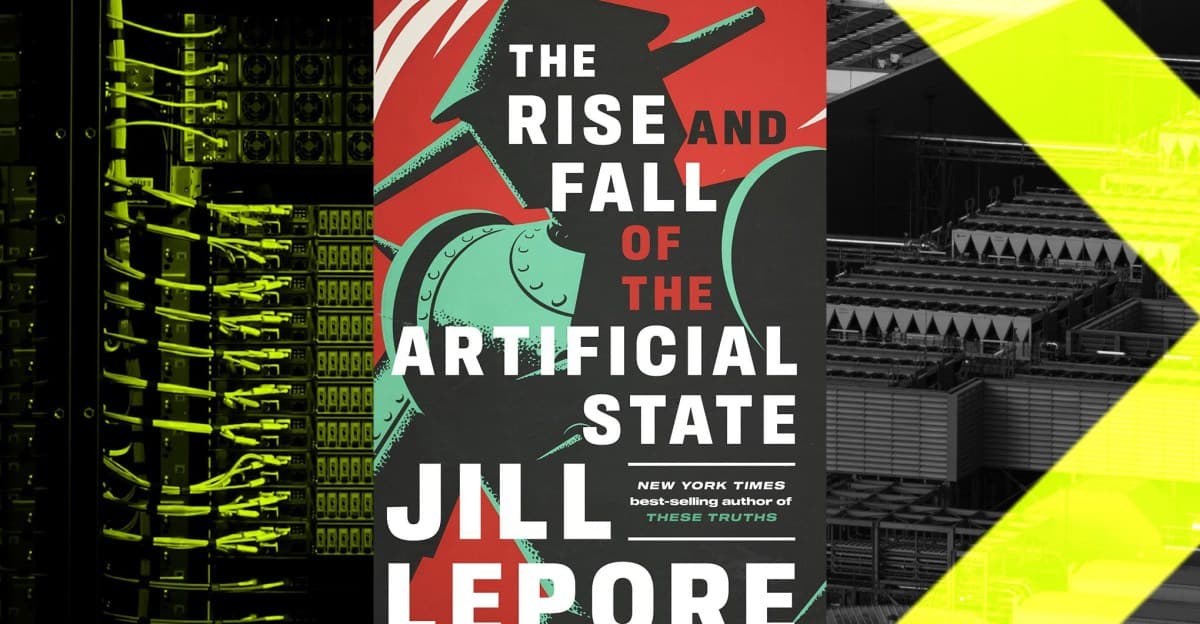
Image: The Verge
Harvard professor Jill Lepore says the backlash against AI and Big Tech may be one of the few hopeful signs in an increasingly automated political system.
Speaking on The Verge’s Decoder podcast about her upcoming book, The Rise and Fall of the Artificial State, due out August 25, Lepore argues that modern systems of measurement—collecting information, turning people into data, and acting on that data at scale—have steadily dehumanized public life. In her view, that process now extends well beyond apps and algorithms into politics, governance, and the basic structure of the state itself.
Lepore describes the “artificial state” as a successor to the liberal nation-state: a system in which core public functions are increasingly handled by private multinational corporations. She points in particular to the privatization of public discourse, where platforms that shape how people get information and exercise citizenship are driven less by democratic deliberation than by the monetization of attention and outrage.
“Our public discourse is almost entirely privatized and owned by corporations.”
A central thread in the interview is how politics moved from person-to-person contact to data extraction. Lepore traces that shift back to scientific polling in the 1930s, when George Gallup founded the American Institute of Public Opinion in 1935. Polling and later data analysis made campaigns more efficient, she said, but replaced the kinds of everyday civic conversations that once held communities together.
She argues that the trend has accelerated sharply in the age of artificial intelligence. Voters now ask tools like ChatGPT how to vote, while campaign messages are increasingly targeted and generated by AI. Lepore’s warning is stark: elections risk becoming “AI versus AI.”

Recommended reading
AI Won’t Replace Coders, but It Will Reshape the Job
Silicon Valley’s political imagination
Lepore also takes aim at the worldview of tech elites including Elon Musk, Peter Thiel, and Sam Altman. She argues that Silicon Valley’s culture has long prized disruption over historical understanding, and that this weakens its ability to think seriously about democracy, literature, and human purpose.
She cites a Joe Rogan appearance in which Altman discussed the idea of AI choosing the US president—partly joking, she said, but not entirely. For Lepore, that line of thinking reflects a broader assumption that if a machine can do something more efficiently, humans should simply hand it over.
What she resists is the premise itself: that efficiency should outrank meaningful human activity, whether in politics, writing, or art. Her hope, as she told Decoder, lies partly in public resistance—including college students booing AI CEOs at graduation ceremonies.

AI Editor
Ava covers the rapidly evolving world of artificial intelligence, from foundational models and research labs to the real-world economics of intelligence. With a background in computational linguistics, she cuts through the hype to find out what actually works. She firmly believes that benchmarks are just marketing until reproduced in the wild.
via The Verge