• 2 min read
Korean battery cooling cuts fluid use by up to 90%
Researchers in South Korea say a hybrid battery cooling system can keep packs below 35 °C while using just 10–20% of the dielectric fluid of full immersion.
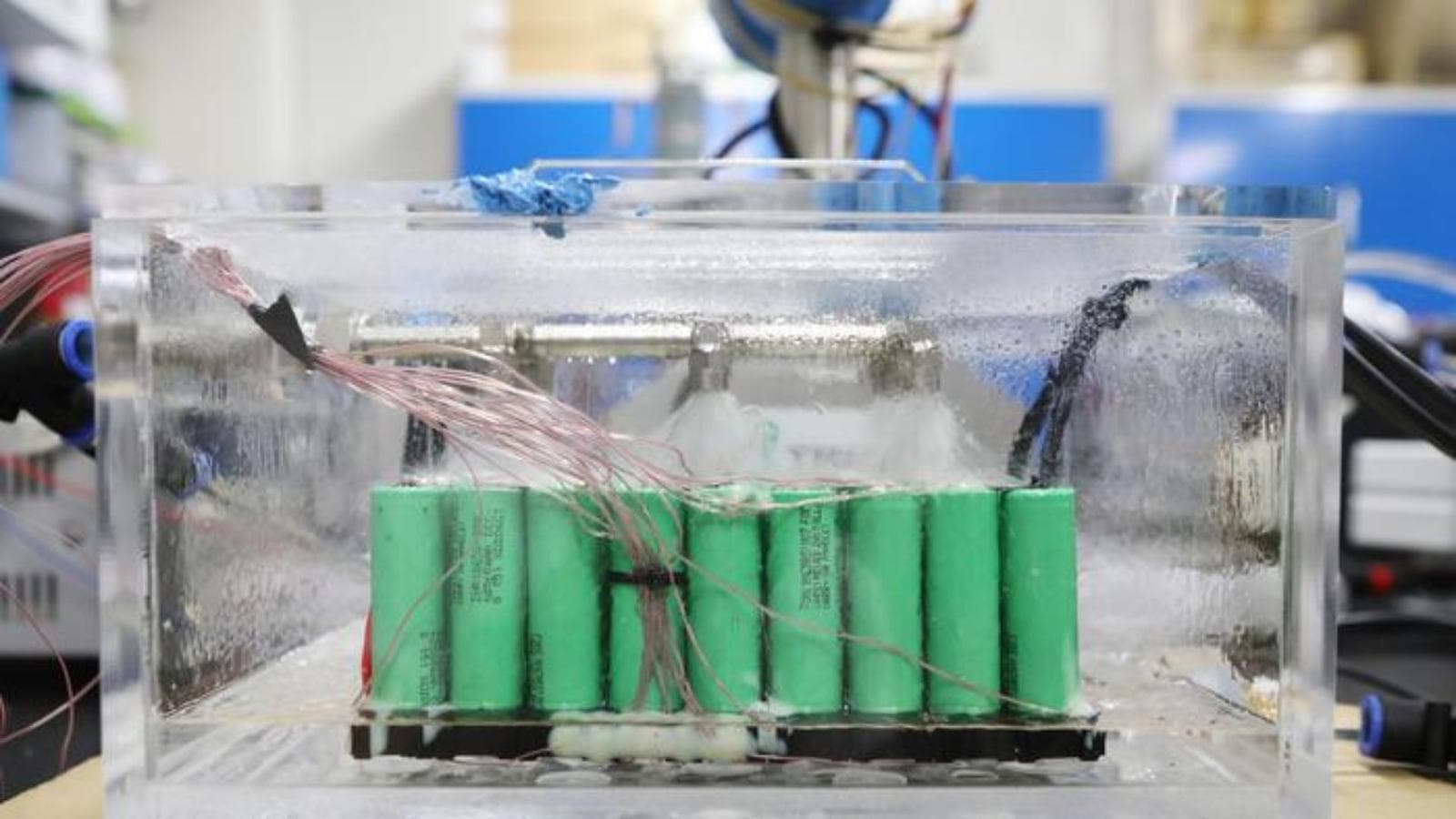
Image: iXBT
Researchers in South Korea have developed a lithium-ion battery cooling system that uses 10–20% of the dielectric fluid required by traditional full-immersion designs, while also reducing pack weight and cost. The approach combines top-side liquid spray with partial immersion of the lower part of the battery pack.
That matters because lithium-ion batteries need effective heat removal to avoid thermal runaway — an uncontrolled temperature rise inside a cell that can lead to fire. One of the most reliable protections is to fully immerse cells in a non-flammable dielectric liquid, but that adds both mass and expense.
The new KIMM system is designed to keep the advantages of immersion cooling without needing nearly as much fluid. According to the researchers, the spray cools the hottest parts of the cells quickly, while the liquid layer at the bottom provides forced convection, moving heat away through fluid motion.
The result, they say, is a battery pack that stays below 35 °C even under heavy charging and discharging. Compared with conventional full-immersion cooling, the technology cuts the required amount of dielectric fluid by 80–90%.

Recommended reading
NASA’s Psyche snaps detailed Mars flyby mosaic
That could make the setup easier to use in electric vehicles and large energy storage systems (ESS) connected to power grids, where cooling performance, weight, and cost all matter. The fluid itself remains fully non-flammable, and the researchers say that if a battery cell is damaged, it can also act as an internal fire-suppression medium.
The next step for the Korea Institute of Machinery and Materials team is to use AI-based optimization methods to identify new dielectric fluids with better thermophysical properties.

Frontier Editor
Dan is our resident futurist, covering electric mobility, space exploration, and the smart home. He's interested in atoms just as much as bits. Whether it's a new battery chemistry, a reusable rocket, or a protocol that finally makes IoT devices talk to each other, Dan breaks down the engineering that pushes humanity forward.
via iXBT