• 4 min read
Perovskite cells hit 1,210 hours with molecular interface tweaks
HKUST researchers report two perovskite tandem solar advances, including 29.1% efficiency and stability lasting 1,210 hours under heat and light.
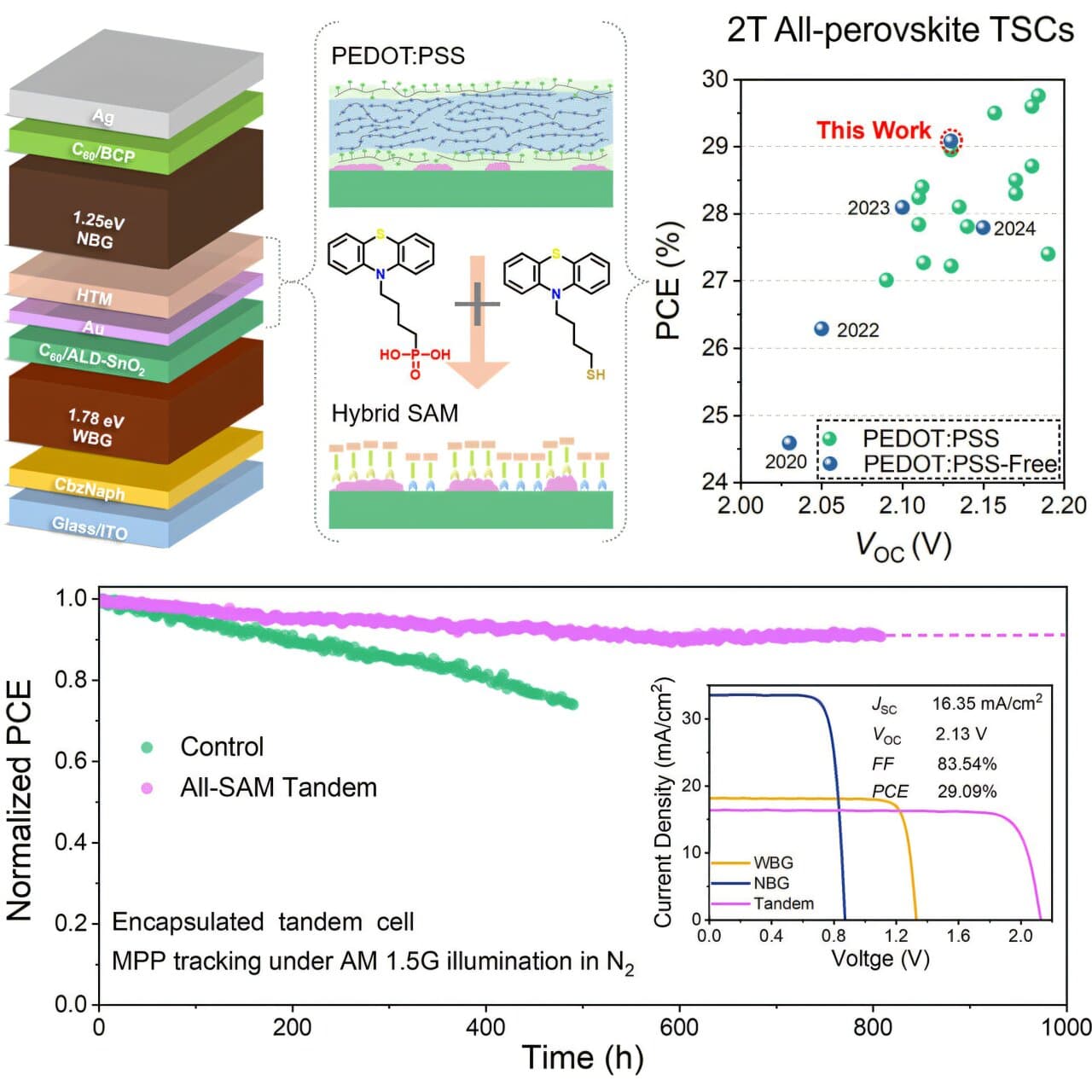
Image: TechXplore
Solar-cell performance often hinges on a few atomic layers where materials meet, and HKUST researchers say those interfaces can now deliver both higher efficiency and much longer life for perovskite tandem solar cells.
In two studies published in Joule and Nature Communications, the team showed that carefully designed molecular layers can steer crystallization, cut defects, improve charge transport, and slow degradation. Professor Lin Yen-Hung, assistant professor in the Department of Electronic and Computer Engineering at HKUST, said the work shows that “every interface matters” in modern perovskite tandems.
“Perovskite tandem solar cells have reached a stage where every interface matters. These two studies highlight a shared principle: molecular interfaces can be designed as active platforms to control crystallization, reduce energy loss, facilitate charge transport, and improve long-term stability across different tandem architectures.”
PEDOT:PSS-free tandems reach 29.1%
The Joule paper focused on two-terminal monolithic all-perovskite tandem solar cells. The researchers targeted a buried interface in the narrow-bandgap tin-lead perovskite subcell, where the commonly used hole-transport material PEDOT:PSS can absorb moisture, interfere with perovskite precursors, and trigger phase segregation.
Using in situ characterization, the team found that PEDOT:PSS drives an unstable crystallization pathway in mixed tin-lead perovskite films. They replaced it with a phenothiazine-functionalized self-assembled monolayer, 4PAPT, which promoted direct phase transition, improved crystal orientation, and reduced nonradiative recombination losses.
Recommended reading
Korean battery cooling cuts fluid use by up to 90%
That change produced a 23.2%-efficient narrow-bandgap single-junction perovskite cell. The same approach, extended with a hybrid self-assembled monolayer interconnecting layer using thiol and phosphonic acid anchoring groups on SnO2/Au surfaces, enabled a PEDOT:PSS-free all-perovskite tandem with 29.1% power conversion efficiency. According to the study, that is the highest reported efficiency so far for PEDOT:PSS-free all-perovskite tandem configurations.
Encapsulated devices retained 90% of their initial efficiency after more than 800 hours of continuous operation at around 40°C (104°F) under simulated one-sun illumination and maximum power point tracking.
“The instability of PEDOT:PSS is not only an issue with the material itself; it also affects how the perovskite film forms at the buried interface. By replacing this polymer with molecularly designed self-assembled monolayers, we were able to control crystallization from the start and carry that benefit into high-efficiency tandem devices.”
All-inorganic tandems survive 1,210 hours at 65°C
The Nature Communications study took a different route: four-terminal all-inorganic perovskite tandem solar cells. These materials are attractive for thermal and photostability, but their surfaces remain vulnerable to moisture and defect-related losses.
To address that, the researchers used tetrabutylammonium trifluoromethanesulfonate (TTFS) to build an in situ self-assembled 1D/3D perovskite heterojunction on the absorber surface. The cationic part forms a hydrophobic barrier against moisture, while the anionic part passivates surface defects and helps electron extraction.
The result was a certified 17.10% power conversion efficiency for a semitransparent wide-bandgap all-inorganic perovskite top cell. Paired with a narrow-bandgap all-inorganic bottom cell in a four-terminal tandem setup, the device reached a certified 21.54% efficiency, which the researchers say is the highest certified efficiency for this tandem type.
The stability figures are equally notable: the devices maintained 80% of their initial efficiency after 1,210 hours at 65°C (149°F) and 650 hours at 85°C (185°F) under continuous one-sun maximum power point tracking conditions.
The study also used photoluminescence mapping, photoluminescence quantum yield mapping, and quasi-Fermi-level splitting mapping, with contributions from Zhang Qingqing and Dr. Fion Yeung, to show how the engineered interface reduced energy loss and improved carrier dynamics across the film.
“Across the two studies, our shared focus was to understand what happens at the interface before losses show up in device performance. Optical and optoelectronic characterization allows us to connect molecular design with how charges move, recombine, and ultimately determine solar-cell efficiency.”
The papers are:
- Fengzhu Li et al, Interface-mediated crystallization enables PEDOT:PSS-free all-perovskite tandems with 29.1% efficiency and enhanced durability, Joule (2026). DOI: 10.1016/j.joule.2026.102501
- Hao Zhang et al, Self-assembled 1D/3D heterojunction enables all-inorganic perovskite 4-terminal tandem solar cells with 21.54% certified efficiency, Nature Communications (2026). DOI: 10.1038/s41467-026-72099-z

Frontier Editor
Dan is our resident futurist, covering electric mobility, space exploration, and the smart home. He's interested in atoms just as much as bits. Whether it's a new battery chemistry, a reusable rocket, or a protocol that finally makes IoT devices talk to each other, Dan breaks down the engineering that pushes humanity forward.
via TechXplore