• 2 min read
NASA’s Psyche snaps detailed Mars flyby mosaic
NASA’s Psyche spacecraft captured a color mosaic of Mars during its May 15, 2026 flyby on the way to the metal-rich asteroid Psyche.
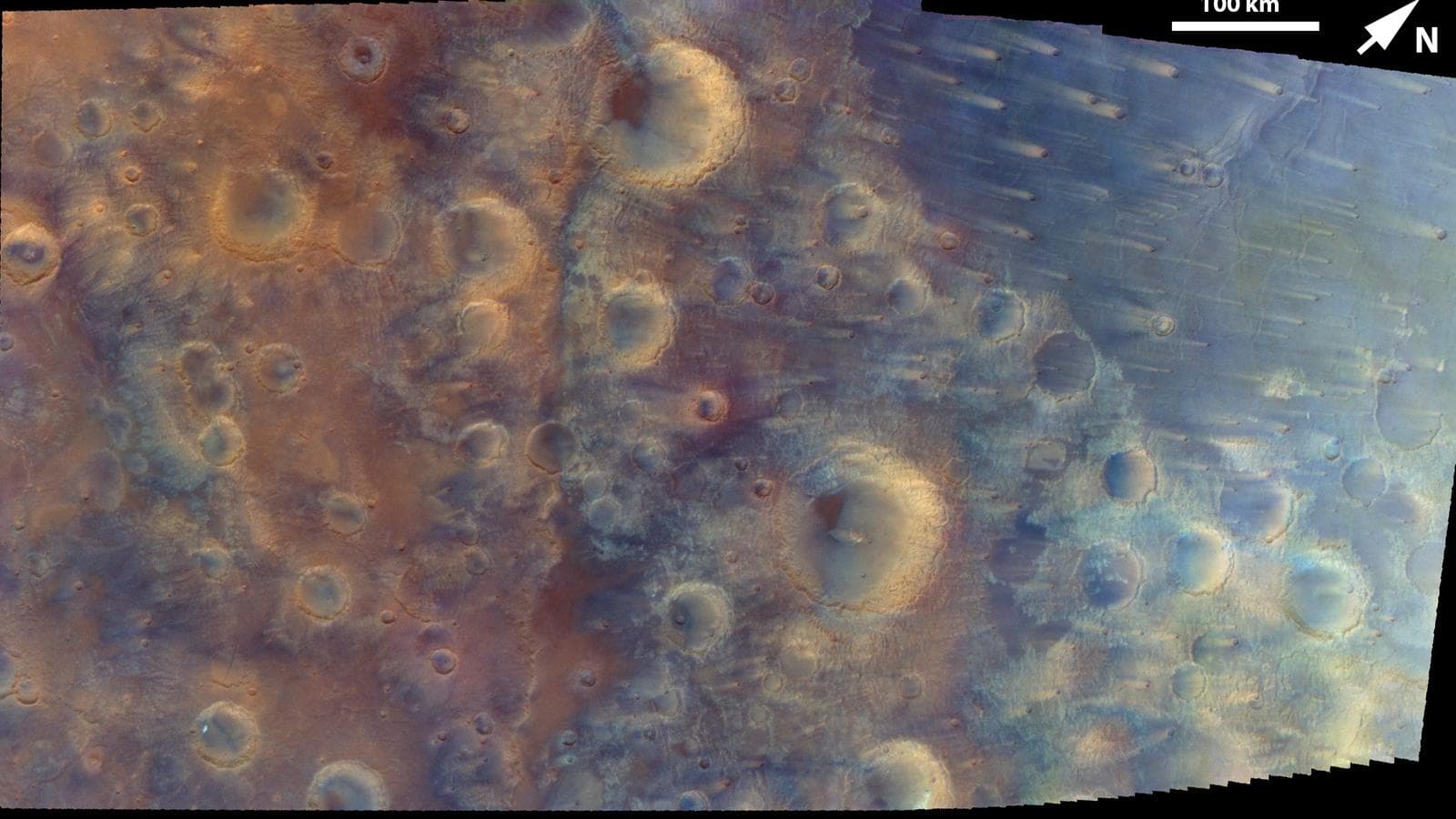
Image: iXBT
On May 15, 2026, NASA’s Psyche spacecraft captured detailed views of Mars as it flew past the planet en route to the asteroid of the same name. The images, taken with the probe’s multispectral camera, were combined into a color mosaic showing terrain in the planet’s southern highlands.
The spacecraft crossed the planet’s disk from northeast to southwest, moving right to left in the image. The mosaic was assembled from observations gathered over 6 minutes, with image resolution ranging from 381 to 440 meters per pixel depending on the area.
Using near-infrared, green, and blue filters, the camera highlighted differences across the Martian surface, including large craters, ridges, wind-shaped features, and volcanic plain materials. The imaged region covers part of Iapygia in the southern highlands, spanning roughly 62 to 78 degrees east longitude and 4 degrees north to 14 degrees south.
Recommended reading
Korean battery cooling cuts fluid use by up to 90%
The largest feature in the mosaic is Fournier crater, an impact crater about 114 km wide, located slightly below the center of the image.
Left of center, the image also captures part of Oenotria Scopuli, an extensive escarpment system tied to the ring structure of the large Isidis impact basin to the northeast. According to the source, formations like these help scientists study Mars’s collision history and the evolution of its surface.
NASA launched Psyche to study the asteroid Psyche in the main asteroid belt between Mars and Jupiter. Scientists believe the object contains a high proportion of metal and may be part of the core of a planetesimal, one of the building blocks of the early planets.
The Mars flyby was part of the spacecraft’s route to its primary target. The asteroid Psyche is expected to capture the spacecraft into orbit in late July 2029, with the main science phase beginning in August. The probe is then expected to spend about 2 years orbiting the asteroid and studying its composition, structure, and origin.

Frontier Editor
Dan is our resident futurist, covering electric mobility, space exploration, and the smart home. He's interested in atoms just as much as bits. Whether it's a new battery chemistry, a reusable rocket, or a protocol that finally makes IoT devices talk to each other, Dan breaks down the engineering that pushes humanity forward.
via iXBT