• 2 min read
LHC’s biggest overhaul aims for 7x more Higgs data
CERN’s collider is offline until around 2030 for its High-Luminosity upgrade, designed to deliver roughly seven times more data.
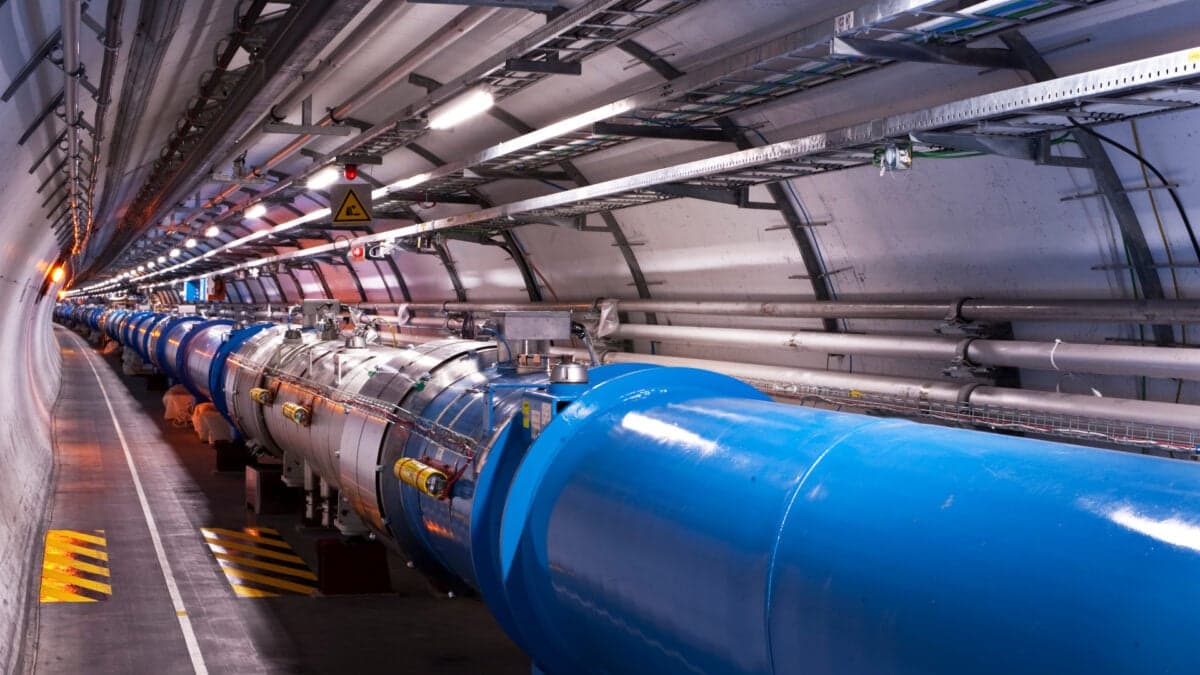
Image: Gizmodo
Deep under the French-Swiss border, CERN’s Large Hadron Collider has gone quiet. The machine is in a long shutdown as teams strip out hardware, install new systems, and prepare its most ambitious upgrade yet. When it returns around 2030, it will operate as the High-Luminosity Large Hadron Collider (HL-LHC), built to deliver roughly seven times more data than the collider that discovered the Higgs boson.
The piece, written by Daniela Bortoletto, a professor and head of particle physics at the University of Oxford, describes the effort from inside the program. Bortoletto previously served in the United States as upgrade coordinator for CMS, one of the LHC’s major experiments, and now works on Atlas in Oxford, where her team is building silicon pixel detector modules for the upgraded inner tracker.
The scientific target is no longer simply finding the Higgs, which the LHC did in 2012. Now researchers want to test whether it behaves exactly as the standard model of particle physics predicts. That means chasing rare processes such as:
- Higgs decay into two muons
- Higgs decay into charm quarks
- Production of Higgs boson pairs, which could reveal the Higgs self-coupling
Those measurements could expose tiny deviations from the standard model, potentially pointing to new particles or forces and helping explain puzzles including dark matter and the universe’s imbalance between matter and antimatter.
Detector upgrades for 200 simultaneous collisions
The accelerator upgrade is only part of the story. At the HL-LHC, each beam crossing is expected to generate up to 200 simultaneous proton-proton interactions, far more than today. Sorting through that pileup requires entirely new detector systems that are faster, more precise, and more resistant to radiation.

Recommended reading
Earth model suggests AI isn’t humanity’s only endgame
Both Atlas and CMS are replacing their inner silicon trackers. The new detectors rely on advances in silicon sensors, ultra-fast electronics, cooling, and lightweight support structures. They also add precision timing: Atlas' High Granularity Timing Detector and a similar system in CMS will measure particle arrival times with a precision of a few tens of trillionths of a second.
That timing information effectively adds a fourth dimension to tracking, helping physicists match particles to the correct collision and isolate rare Higgs events from a huge background.
For particle physics, the stakes are unusually high. The HL-LHC is designed to open a new era of precision Higgs physics—either exposing cracks in the standard model or confirming it with far tighter measurements than ever before.

Frontier Editor
Dan is our resident futurist, covering electric mobility, space exploration, and the smart home. He's interested in atoms just as much as bits. Whether it's a new battery chemistry, a reusable rocket, or a protocol that finally makes IoT devices talk to each other, Dan breaks down the engineering that pushes humanity forward.
via Gizmodo