• 2 min read
These robot clothes crawl onto your body
KAIST and Stanford built prototype garments that inflate and unfurl onto a wearer, aiming to make dressing easier for older and disabled people.
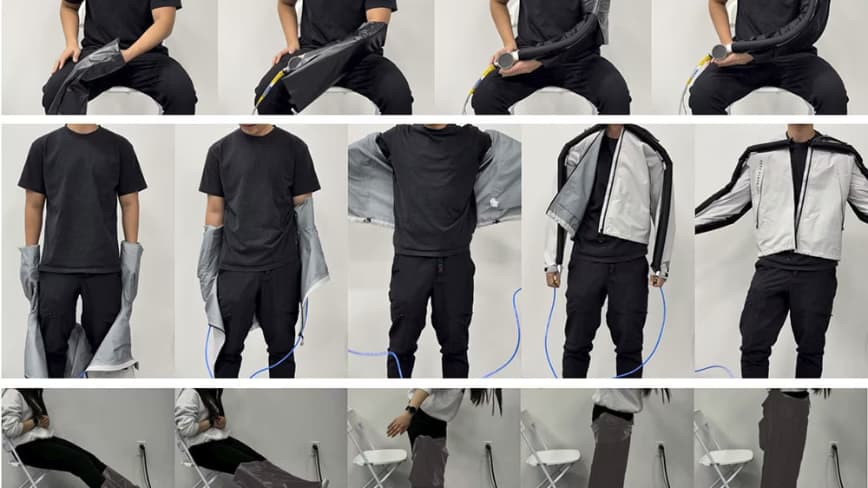
Image: TNW
Getting dressed can become a daily barrier for millions of older and disabled people. Researchers at KAIST in Daejeon and Stanford University have now shown a different approach: clothing that moves onto the wearer by itself.
The system, first reported by Reuters, is called SWAG, short for Self-Wearing Adaptive Garments. Rather than using a rigid robot arm or an exoskeleton to pull clothing into place, the garment deploys itself. The idea comes from vine robots developed in Allison Okamura’s lab at Stanford, where soft machines move forward by everting from their tip — like a party horn unrolling.
SWAG applies that mechanism to clothing. Thin internal tubes, known as subvines, inflate and extend along a limb, turning the fabric inside out as they move. Because the material unrolls onto the skin instead of being dragged across it, friction stays low — an important detail for people with thin, bruised, or sore skin.
Recommended reading
Rosenergoatom tests hydrogen electrolyzer at 5 m³ per hour
The outer garment itself is not fully pressurized. Instead, the inflatable channels sit around a cylindrical fabric sheath and do the work while the clothing remains soft. According to the researchers, that also helps the system adapt to whatever posture the wearer is already in, reducing the need for the cameras and precise motion planning used in many conventional dressing robots.
“Our work extends the core principles of soft growing robots into assistive dressing technologies that can directly improve daily life.”
The project brings together Jee-Hwan Ryu of KAIST and Okamura, a longtime researcher in the field. Nam Gyun Kim, also at KAIST, is the lead author, working with Stanford mechanical engineering students on the hardware. So far, the team has built prototype sleeves, jackets, and trousers using the same unfurling design.
The work appeared in IEEE Robotics and Automation Letters in November 2025. This year, it received the journal’s Best Paper Award at the ICRA conference, one of five papers selected from more than 1,700 published over the year. It was also the second year running that Ryu’s group won the honor.
For now, SWAG remains a research prototype. The team says performance depends heavily on fabric choice and on the tradeoff between stiffness and flexibility, which becomes harder to manage as more subvines are added. Still, a jacket that climbs quietly up an arm offers a very different vision of assistive care than a robot looming over a bed.

Frontier Editor
Dan is our resident futurist, covering electric mobility, space exploration, and the smart home. He's interested in atoms just as much as bits. Whether it's a new battery chemistry, a reusable rocket, or a protocol that finally makes IoT devices talk to each other, Dan breaks down the engineering that pushes humanity forward.
via TNW