• 2 min read
SanDisk’s 2230 SSD sets a new PCIe 4.0 bar
The SanDisk Optimus GX 7100M is the fastest PCIe 4.0 SSD PCWorld has tested, but its roughly $240 1TB price is hard to ignore.
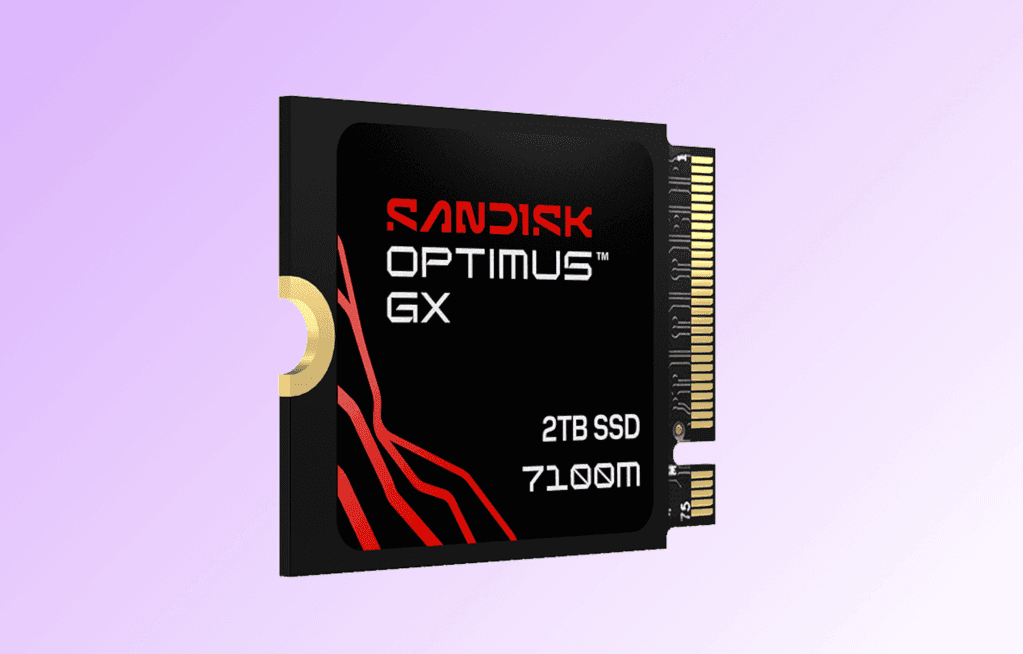
Image: FastCopy
SanDisk’s Optimus GX 7100M is a tiny 2230 SSD built for handheld gaming PCs, but PCWorld says it currently stands as the fastest PCIe 4.0 NVMe drive it has tested in any form factor. The catch is price: about $240 for 1TB and $450 for 2TB, with PCWorld’s listed price at $229.99.
PCWorld gave the drive an Editors' Choice award and praised three things in particular: top-end PCIe 4.0 performance, especially strong 4K results, and the 2230 form factor that fits devices like handheld consoles. The main downside was simple: it is, in the reviewer’s words, “really, really expensive.”
The drive uses a SanDisk in-house controller, TLC NAND, and a Host Memory Buffer design, borrowing roughly 64MB to 72MB of system memory as primary cache. PCWorld’s testing found that at least 25 percent of the NAND is used as secondary cache in SLC mode. SanDisk rates the SSD for a five-year warranty and 600TBW per terabyte of capacity.
Recommended reading
DDR5 prices surge again as CPU cost hike looms
Performance against Corsair’s 2230 rivals
In PCWorld’s benchmarks, the 2TB GX 7100M beat every PCIe 4.0 SSD the publication has tested. It also came surprisingly close to the PCIe 5.0 Corsair MP700 Micro, and in CrystalDiskMark 8 4K tests it actually beat that drive by 33 to 61 percent.
Real-world file transfers showed a smaller gap, though the older Corsair MP600 Micro was clearly slower. In 48GB transfers, differences were harder to spot in normal use, while the 450GB write was effectively a tie between the GX 7100M and MP700 Micro: the Corsair trailed in Windows Explorer but finished 15 seconds faster in FastCopy.
On an additional 900GB contiguous write, the SanDisk drive dropped to around 600MBps to 800MBps. PCWorld said that slowdown is not exceptional, but also not severe compared with some QLC drives or older TLC models.
The review’s bottom line is straightforward: if you want the best PCIe 4.0 SSD performance in a 2230 size and can afford it, this is the one to buy. If not, cheaper drives are still fast enough that many users will only notice the difference during very large transfers.

Computing Editor
Tomas lives in the terminal. He covers chips, laptops, and operating systems with a focus on performance and efficiency. He reads kernel changelogs the way other people read fiction, and he's always on the hunt for the perfect mechanical keyboard switch. If it processes data, Tomas has an opinion on it.
via PCWorld