• 3 min read
Self-healing e-skin works underwater for robots and divers
NUS researchers built a self-powered electronic skin that senses touch, detects damage, and heals underwater for diving gloves and robotic hands.
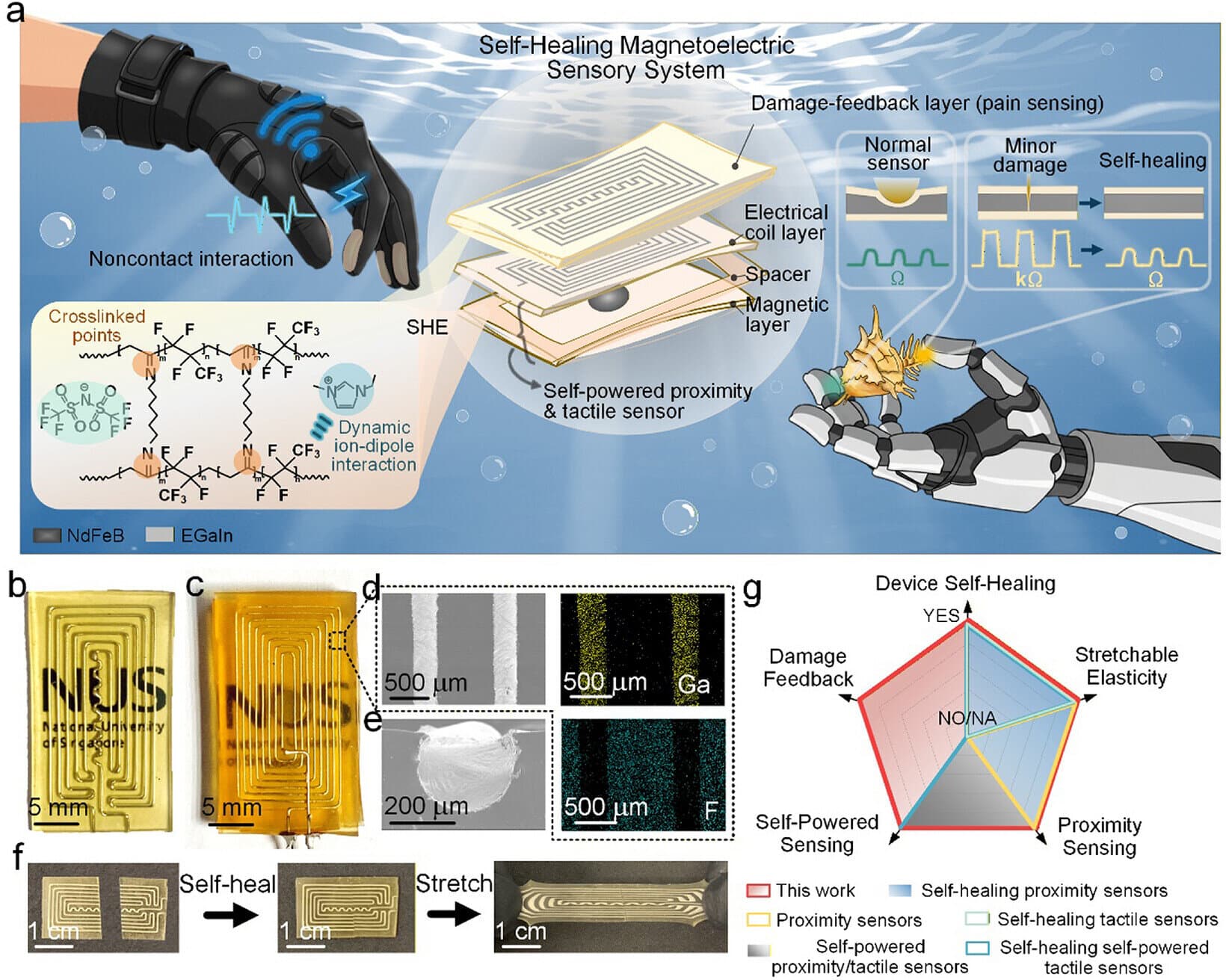
Image: TechXplore
A team at the National University of Singapore (NUS) has developed a self-healing magnetoelectric sensory system, or SMES, designed to keep working in one of electronics' toughest environments: underwater. Led by Assistant Professor Tan Yu Jun of the Department of Mechanical Engineering at the College of Design and Engineering, the researchers say the system combines self-powered touch and proximity sensing, damage detection, and autonomous self-repair in a single device.
The work was published in Advanced Materials on April 18, 2026. According to the team, the technology could be useful for soft robotics, electronic skins, and other underwater human-machine interfaces where durability matters.
The design is modeled on biological skin. It uses a top damage-sensing layer above an electromagnetic sensing layer, both built on a stretchable self-healing elastomer with liquid-metal conductors. When the top layer is pricked, punctured, or cut, its electrical resistance rises sharply, acting like a pain signal. The material then repairs itself through reversible molecular interactions when damaged surfaces are brought back into contact.
Recommended reading
Roscosmos tests AT-Gonets modem that keeps data after power loss
Tan said the sensor can recover its original electrical performance within seconds after needle-prick damage without external intervention. For cuts, brief mechanical pressure starts the repair process, with full functionality returning after a longer healing period. The elastomer reaches up to 92% elastic recovery and, under mild heating, about 82% healing efficiency in air after seven days and nearly 100% underwater after 10 days.
“In our bodies, pain is a protective alarm. It tells us when something is wrong so we can respond before more damage is done.” “Our work gives underwater electronics that same capability, enabling devices to sense injury and begin healing autonomously.”
Performance and prototypes
The sensor generates its own electrical signals through electromagnetic induction. A small magnet and a coil of liquid-metal wire sit in adjacent layers; when pressure is applied or an object moves nearby, the magnet shifts relative to the coil, inducing a voltage. That allows both proximity sensing and tactile sensing without an external power source.
In testing, the device posted a response time of about 41 milliseconds and maintained stable output after 10,000 cycles. Its proximity-sensing performance also stayed consistent after 10 days of underwater immersion, including in simulated seawater.
The team built two working demos:
- A smart diving glove that maps five hand gestures to wireless commands sent by Bluetooth to a smartphone: “Normal,” “Going up,” “Going down,” “Holding,” and “Help.” Red LEDs light up when severe damage is detected.
- A robotic hand for underwater grasping and delivery. It uses green, yellow, and red LEDs to show normal operation, minor damage that can quickly self-repair, and severe structural damage requiring intervention.
During tests, the robotic hand grasped and transported objects underwater while detecting and recovering from puncture damage caused by sharp shells.
“The SMES, our electronic skin, can feel, detect damage and recover after damage whether on land, in the air or underwater, yet it does not require power.” “We hope to integrate SMES with real robots, prosthetics and wearable devices. The ultimate goal is to develop soft machines that can, even in unpredictable environments, sense their surroundings, recognize when they are damaged and recover their function, much like living skin.”
The paper is “A Self‐Healing Magnetoelectric Sensor with Pain Sensing for Underwater Soft Electronics” by Xuan Zhang et al., published in Advanced Materials (2026) with DOI 10.1002/adma.202523052.

Frontier Editor
Dan is our resident futurist, covering electric mobility, space exploration, and the smart home. He's interested in atoms just as much as bits. Whether it's a new battery chemistry, a reusable rocket, or a protocol that finally makes IoT devices talk to each other, Dan breaks down the engineering that pushes humanity forward.
via TechXplore