• 2 min read
Spinning drone nearly vanishes in flight
Northwestern’s Phantom Twist uses motion blur, not camouflage, to become about 10 times less visible than a standard quadcopter.
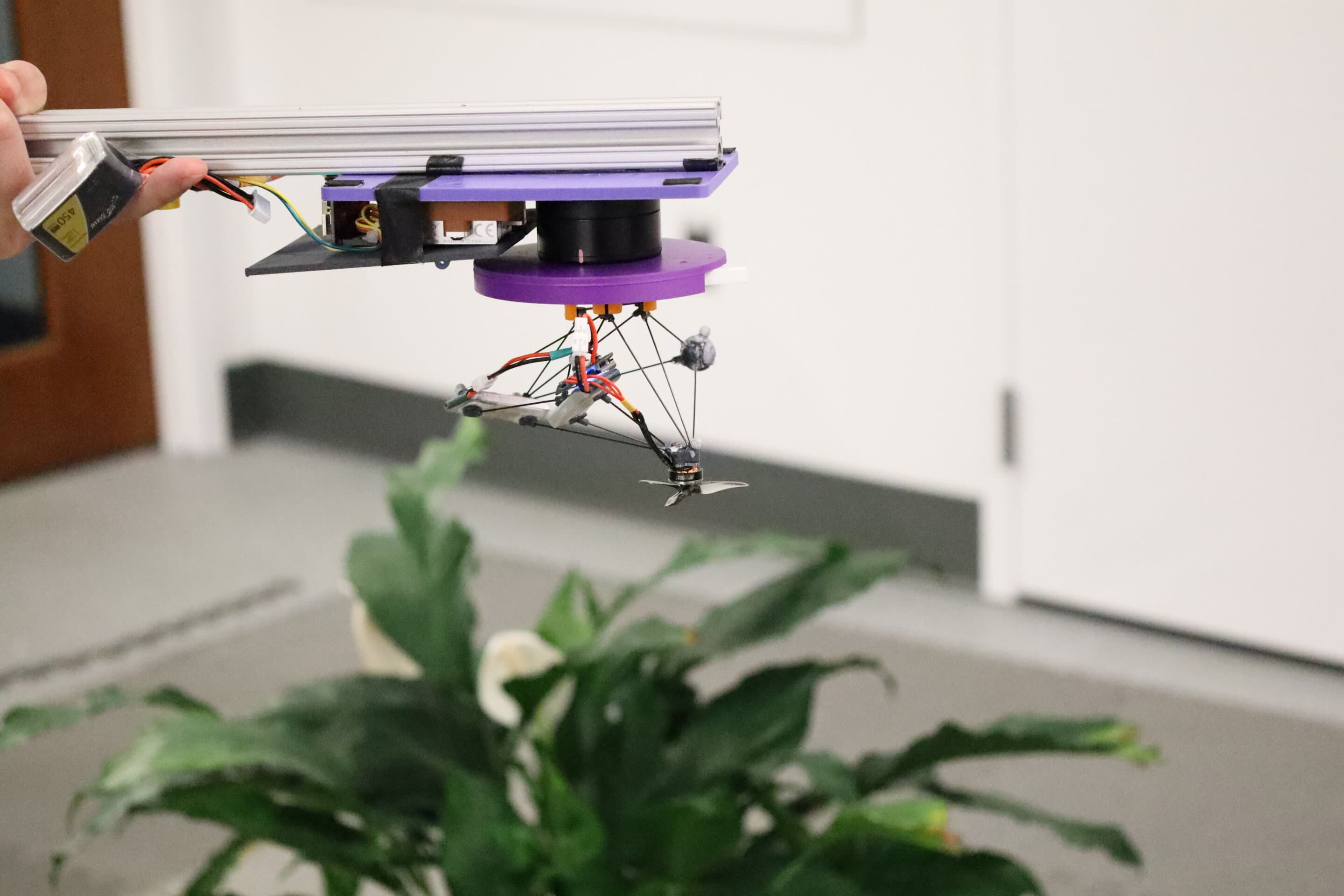
Image: TechXplore
Northwestern University researchers have built a drone that is designed to be hard to see in flight by exploiting motion blur rather than camouflage or transparent materials. Called Phantom Twist, the aircraft spins at up to 25 times per second, turning its body into what the team describes as a faint, semi-transparent smudge against the background.
The work was presented at Robotics: Science and Systems 2026 in Sydney, Australia, in a talk titled “Computational Design of a Low-Visibility UAV Using Human-Aligned Perceptual Metric,” part of the “Robot & Sensor Design” session.
“Most efforts to hide drones focus on making them look like their surroundings. Instead, we asked whether we could design the drone itself around the way humans perceive motion. This idea of low visibility through persistent motion is something few people have explored.”
Unlike a conventional quadcopter, Phantom Twist uses one motor and one propeller. The propeller spins one way while the rest of the drone rotates in the opposite direction, leaving no stationary body parts for the eye to lock onto.
How Northwestern designed Phantom Twist
The team first generated roughly 20,000 drone configurations that could achieve stable flight. It then used AI and optimization algorithms to rearrange major components including the motor, propeller, circuit board, counterweight, and batteries.

Recommended reading
Samsung 990 SSD hits 7,250 MB/s with a 2TB option
Researchers simulated each design in flight, overlaid the images onto 100 real-world backgrounds, and scored how noticeable each one appeared using a perception model meant to approximate human vision. The 500 lowest-scoring designs were then further optimized before the team built the final candidate.
According to the researchers' visibility metric, the optimized drone is about 10 times less visually perceptible than a conventional quadcopter.
“The human eye takes time to accumulate signals, roughly analogous to the exposure time of a camera. When an object spins quickly, we perceive it as blurring out and losing distinct features. Because this new drone is almost entirely transparent, its few opaque components are visually averaged with the background for an overall appearance of a slight haze.”
Current limits and intended uses
The researchers say a lower-visibility drone could reduce disruption during tasks such as:
- monitoring nesting birds
- surveying wetlands
- inspecting aging infrastructure
The current design is not invisible. Its propeller is audible, and some wires and support rods remain visible. Rubenstein said future versions could use more transparent materials or quieter propulsion to make the drone even less noticeable.
Northwestern co-authors include Emma Alexander, Sam Kriegman, and David Matthews. The study’s co-first authors are Jingxian Wang and Chen Yu.

Computing Editor
Tomas lives in the terminal. He covers chips, laptops, and operating systems with a focus on performance and efficiency. He reads kernel changelogs the way other people read fiction, and he's always on the hunt for the perfect mechanical keyboard switch. If it processes data, Tomas has an opinion on it.
via TechXplore