• 2 min read
Sponge-inspired metamaterials cut vibrations and boost strength
UC Berkeley and Harvard used deep-sea sponge geometry to design metamaterials that raised buckling load by about 140% and reduced vortex shedding.
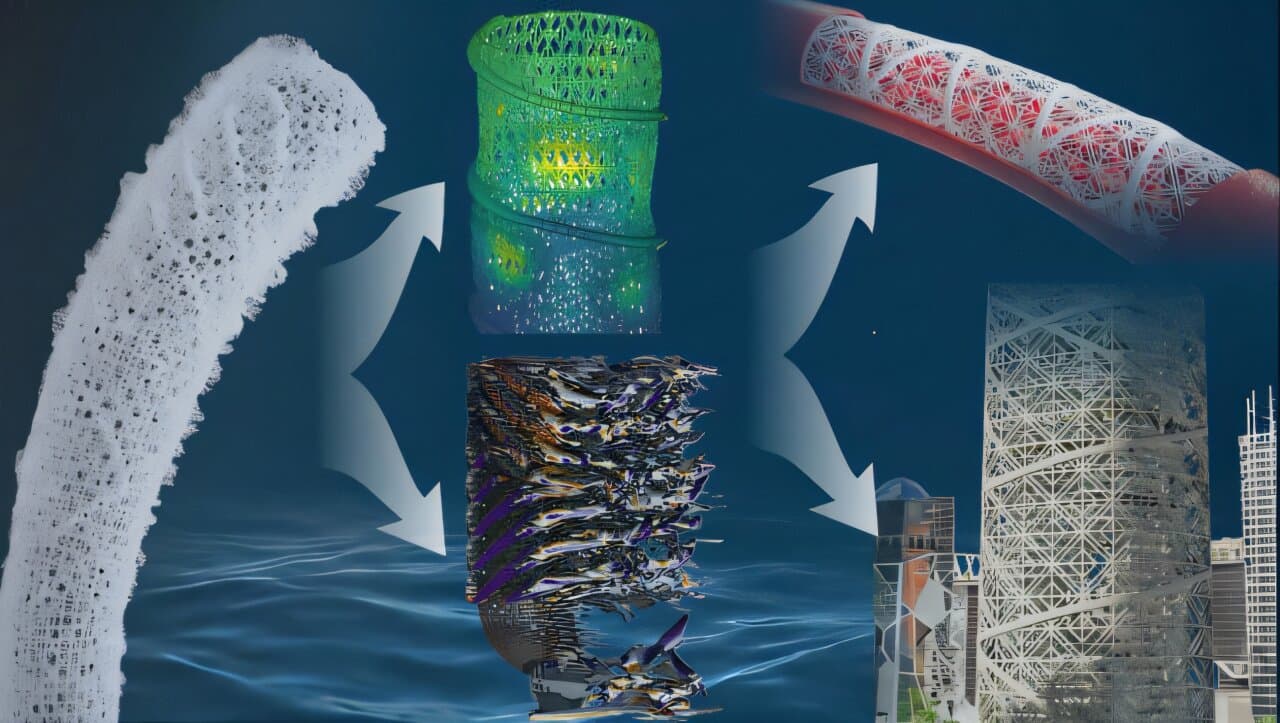
Image: TechXplore
A deep-sea glass sponge has inspired a new class of metamaterials that can do two things engineers usually have to trade off: stay light and strong while also handling fluid flow without triggering damaging vibrations.
Researchers at UC Berkeley and Harvard University reported in Nature Communications that they built an automated design framework combining finite element analysis (FEA), computational fluid dynamics (CFD), and optimization tools. According to Costas Grigoropoulos, professor of mechanical engineering at UC Berkeley and the study’s co-principal investigator with Petros Koumoutsakos of Harvard, the system lets users optimize both structural and fluidic behavior at the same time.
“Using this novel approach, we were able to optimize for both the structural and the fluidic responses of our material—something that hasn’t ever been done before in metamaterial design.”
The biological model is Euplectella aspergillum, also known as Venus' flower basket, a glass sponge that lives below 500 meters (1,640 feet) and can survive for millennia. Its silica skeleton is both tough and flexible, with a lattice geometry that helps it tolerate high water pressure and strong currents while guiding flow around and through the structure.
Timon Meier, a graduate researcher in mechanical engineering and the study’s co-lead author, said the team wanted a structure that used as little material as possible while remaining rigid and able to carry large loads. On the fluid side, the goal was to avoid vortex-induced vibration, where alternating vortices behind an object create oscillating forces that can add stress and fatigue.

Recommended reading
German team speeds PFAS breakdown in water
What the sponge-inspired designs achieved
The framework evaluates hundreds of possible designs through repeated simulation cycles, then narrows in on options unlikely to be improved by further iterations. The researchers also 3D-printed optimized structures and tested them experimentally, working with Simo Mäkiharju’s lab on flow measurements and Rayne Zheng’s lab on mechanical-property validation.
On average, the optimized metamaterials increased buckling load by about 140% compared with randomly selected control structures. The team also found that porosities as low as 5% could significantly reduce vortex shedding without undermining structural stability. One example was a nearly solid cylinder with helical ridges and just 5% open area, enough to significantly suppress vibrations.
The researchers say the approach could eventually be useful for:
- support struts for ocean structures such as underwater pipelines
- medical stents that restore bodily fluid flow
- aerostructures including aircraft wings and helicopter rudders
The paper is “Optimized mechano-fluidic metamaterials inspired by deep-sea sponges” by Timon Meier et al, published in Nature Communications (2026) with DOI 10.1038/s41467-026-72612-4.

Frontier Editor
Dan is our resident futurist, covering electric mobility, space exploration, and the smart home. He's interested in atoms just as much as bits. Whether it's a new battery chemistry, a reusable rocket, or a protocol that finally makes IoT devices talk to each other, Dan breaks down the engineering that pushes humanity forward.
via TechXplore