• 2 min read
UCLA puts terahertz system on one chip
A UCLA-led team integrated terahertz generation, detection, modulation, and amplification onto one semiconductor chip using quantum well structures.
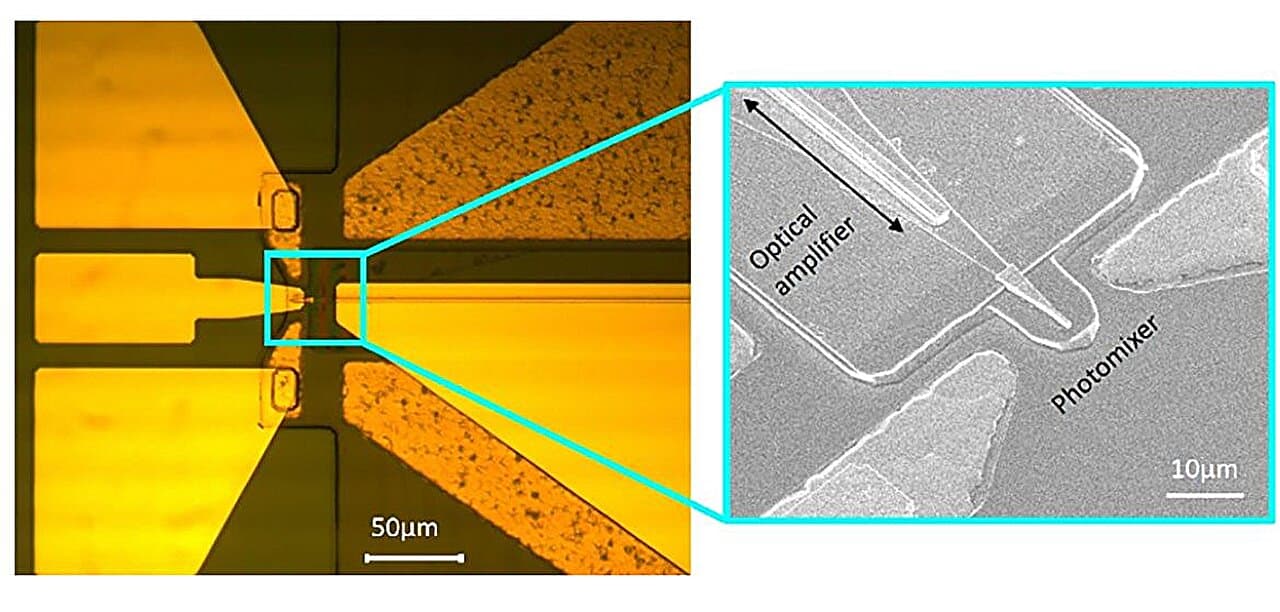
Image: TechXplore
Terahertz technology has long promised ultrafast wireless communication, security screening, remote sensing, and medical imaging, but the hardware has stayed stubbornly large. A UCLA-led team now says it has integrated the core functions of a terahertz optoelectronic system onto a single semiconductor chip compatible with modern photonic integrated circuits.
The work, published in Nature Communications, targets a part of the electromagnetic spectrum between infrared light and microwaves. Today’s terahertz optoelectronic systems usually depend on separate lasers, amplifiers, modulators, sources, and detectors that must be fabricated, aligned, and connected individually, which has kept them mostly in lab settings.
According to the researchers, the new approach adapts terahertz generation and detection to standard photonic chip platforms, offering a path to compact, mass-producible devices.
“Terahertz optoelectronic systems have been bulky, expensive, power-hungry and difficult to scale for widespread use.” “By demonstrating that many of these functions can be integrated onto a single chip using proven industry-standard fabrication platforms, our study opens the door to practical, scalable terahertz technologies for real-world applications.”
The key to the result is the use of quantum well semiconductor structures—ultrathin material layers already common in photonic integrated circuits. The team showed that these structures can both generate and detect terahertz signals through gain-enhanced interband photomixing, a process in which two laser beams combine to produce signals at a chosen wavelength.
The researchers said the chip delivered highly efficient terahertz generation and highly sensitive terahertz detection relative to existing photomixer-based terahertz technologies.

Recommended reading
Samsung 990 SSD hits 7,250 MB/s with a 2TB option
The paper is “Terahertz generation and detection through gain-enhanced interband photomixing in quantum well structures” by Yifan Zhao et al, published in Nature Communications (2026) with DOI 10.1038/s41467-026-73080-6.

Computing Editor
Tomas lives in the terminal. He covers chips, laptops, and operating systems with a focus on performance and efficiency. He reads kernel changelogs the way other people read fiction, and he's always on the hunt for the perfect mechanical keyboard switch. If it processes data, Tomas has an opinion on it.
via TechXplore