• 2 min read
31% solar module drops indium for cheap tin oxide
Researchers built a commercial-size tandem solar mini-module with 31% certified efficiency using tin oxide instead of scarce indium.
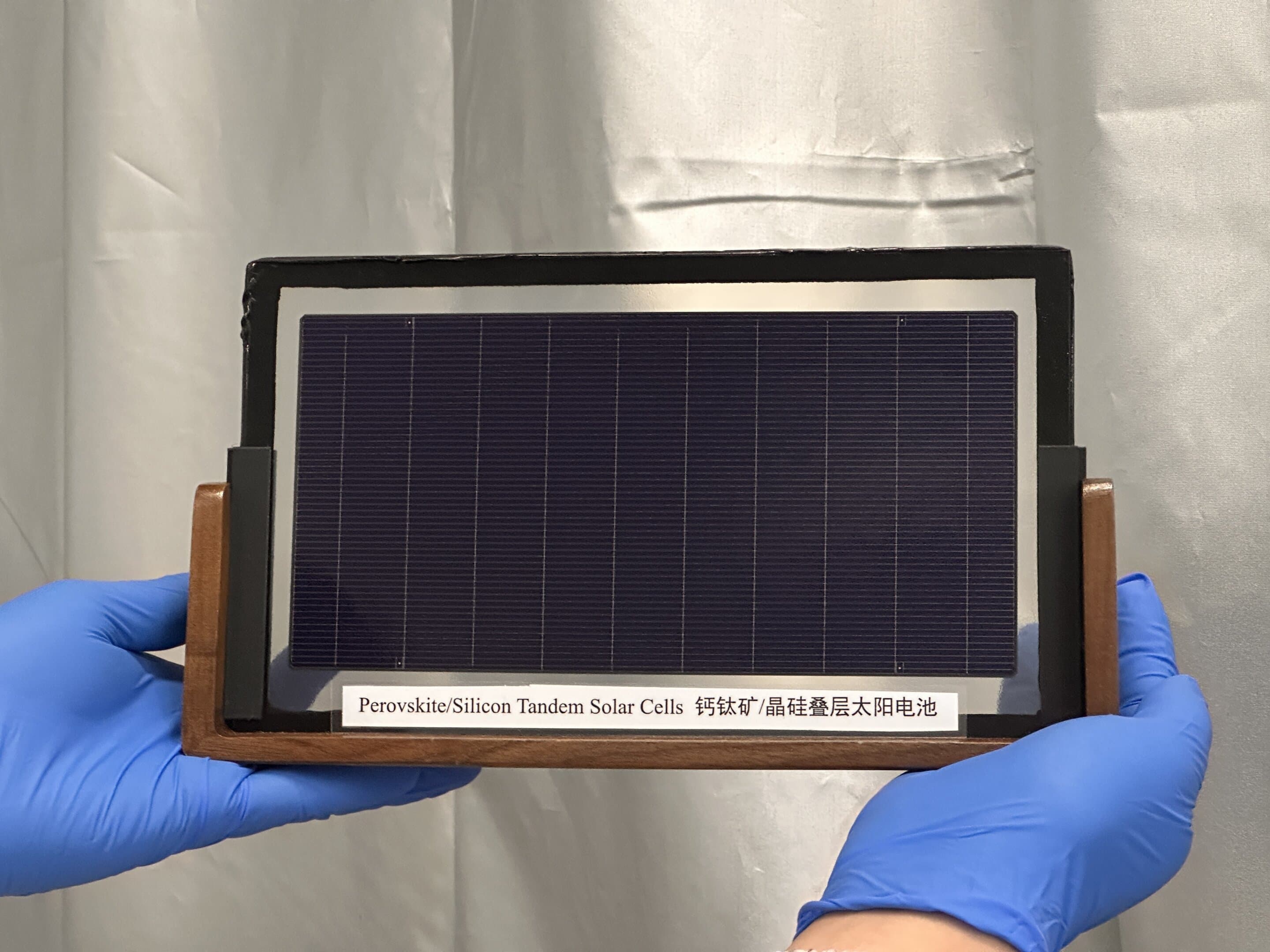
Image: TechXplore
An international research team says it has built the first high-performance, commercial-size tandem solar cell that does not use indium, replacing the scarce and costly metal with tin oxide. The result, published in Science, delivered a certified efficiency of 31% in a commercial-size mini-module while using a material the researchers say costs just 1% as much as indium.
According to Monash University, the work could help move next-generation tandem solar cells closer to commercial production, with the promise of cheaper panels that generate more electricity from the same sunlight. Yuan Cheng, a professor at Monash Suzhou and the Department of Materials Science and Engineering at Monash, said the project marks the first large-area, highly efficient indium-free perovskite tandem solar cell.
“Considering the cost of tin is a mere 1% of that of indium, this breakthrough unveils a new material paradigm and a highly viable engineering route for low-cost, sustainable and scalable tandem photovoltaics.”
The team used a low-damage reactive plasma deposition process to replace indium-based oxide with tin oxide (SnOx). Cheng said the researchers first achieved a certified efficiency of 33.% on 1 cm2 using RPD-SnOx films as the recombination layer, then extended the approach to both the front and rear transparent electrodes.
That allowed the group to scale the technology to a 207.9 cm2 mini-module, where it reached a certified efficiency of 31.0%. The devices also withstood heat, humidity, and more than three months of outdoor operation while maintaining strong performance.
The paper is Wei Shi et al, _Indium-free perovskite/silicon tandem solar cells with tin oxide recombination layer and electrodes_, Science (2026). DOI: 10.1126/science.aef5355.

Recommended reading
US Clears First Mirror Satellite to Beam Sunlight at Night

Frontier Editor
Dan is our resident futurist, covering electric mobility, space exploration, and the smart home. He's interested in atoms just as much as bits. Whether it's a new battery chemistry, a reusable rocket, or a protocol that finally makes IoT devices talk to each other, Dan breaks down the engineering that pushes humanity forward.
via TechXplore