• 2 min read
Battery cooling cuts liquid use by 85%
KIMM says its spray-based immersion cooling keeps lithium-ion packs below 35°C at 4C while using 10%–20% of the liquid in full-immersion systems.
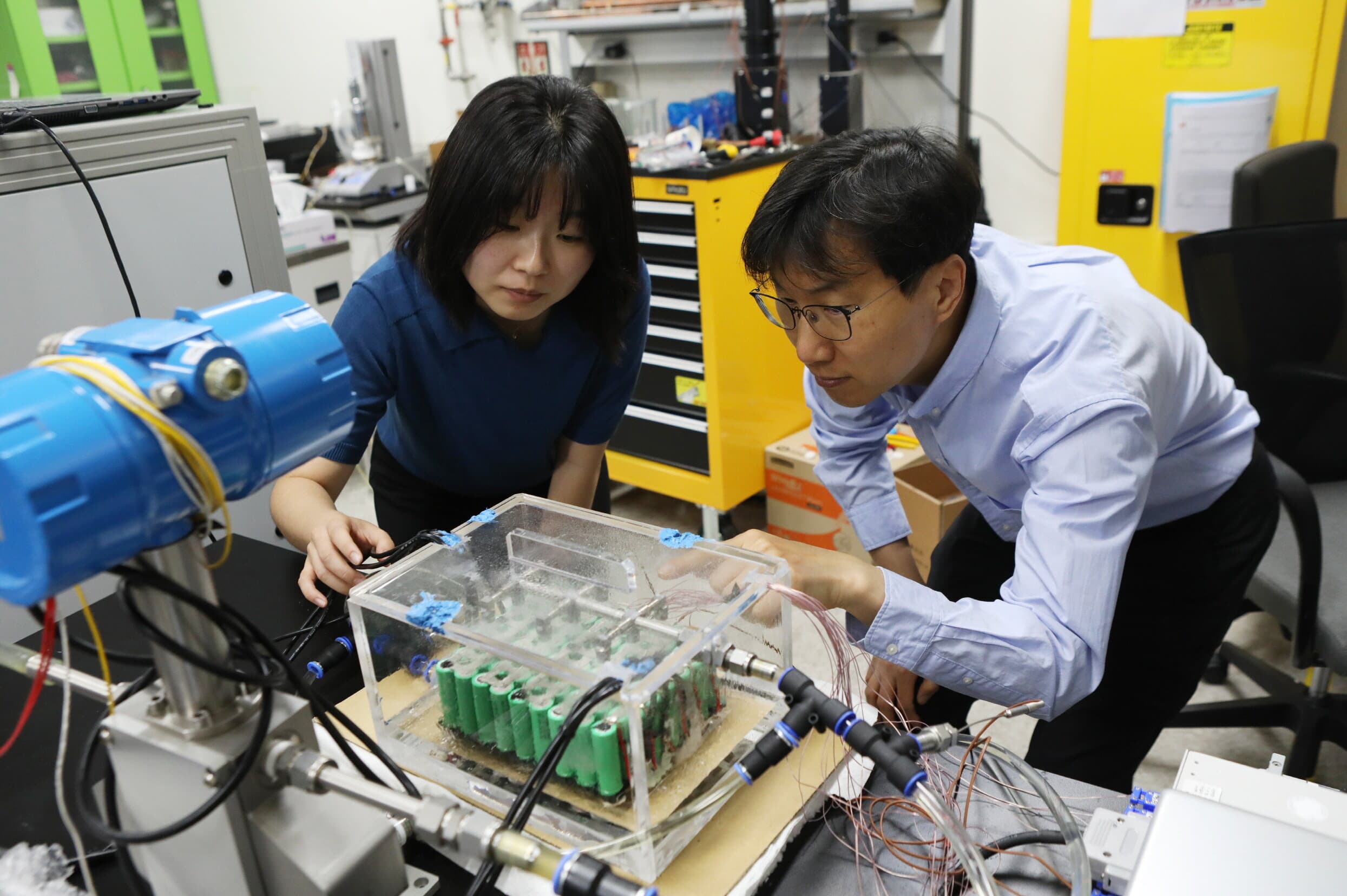
Image: TechXplore
A team at the Korea Institute of Machinery and Materials (KIMM) says it has developed a spray-based immersion cooling system for lithium-ion battery packs that keeps temperatures in check during fast charging and discharging while sharply cutting the amount of cooling liquid required.
According to TechXplore, the system uses a dielectric liquid sprayed onto the top of the battery pack while the bottom remains partially immersed. That combines direct spray cooling with convective cooling from the liquid below. In tests, the setup maintained battery pack temperatures below 35°C (95°F) even under rapid charge and discharge conditions.
The KIMM team, led by Dr. Jinsub Kim, principal researcher at the Heat Pump Research Center of the Research Institute of Carbon-neutral Energy Machinery, published the work in Applied Thermal Engineering. The researchers said the approach is designed to reduce the risk of thermal runaway and battery fires.
Cooling performance under 4C charge-discharge conditions
Conventional air-cooling and liquid-cooling systems typically cool batteries indirectly through heat sinks or cold plates, which can struggle in high-temperature conditions or during rapid charging and discharging. Full immersion cooling avoids some of those limits by placing cells in direct contact with dielectric liquid, but it requires submerging the entire pack, increasing liquid consumption, weight, and cost.
Recommended reading
Google Maps' 3D Android Auto view fixes tricky turns
KIMM says its new design uses only 10%–20% of the dielectric liquid required by conventional immersion systems, a reduction of about 85%. The team reported that it kept the maximum battery-cell temperature below 35°C (95°F) at a 4C charge-discharge rate.
Because the dielectric liquid is nonflammable, the researchers say it could also help suppress fires if a battery incident occurs. KIMM sees potential applications in electric vehicles, large-scale energy storage systems (ESS), and data center energy storage systems.
Kim said the technology can cool lithium-ion battery packs and reduce the risks of thermal runaway and fire with only a small amount of dielectric liquid.
“The spray-based immersion cooling technology can effectively cool lithium-ion battery packs and reduce the risks of thermal runaway and fire using only a small amount of dielectric liquid.”
The team also said it has identified key thermophysical properties of dielectric liquids that maximize cooling performance and plans to extend the work by discovering new dielectric liquids using AI-based optimization technologies.
The research was carried out under the Core Technology Development Project for Energy Demand Management of the Ministry of Climate, Energy and Environment, under a program titled “Development and Demonstration of Ultra-High-Efficiency Data Center Thermal Management Technology Using Immersion Cooling.”
The paper is “A novel spray-based immersion cooling for Li-ion batteries: An experimental comparison with flow immersion,” by Mohammad Ali Yaqteen et al, published in Applied Thermal Engineering (2026) with DOI 10.1016/j.applthermaleng.2025.128873.

Frontier Editor
Dan is our resident futurist, covering electric mobility, space exploration, and the smart home. He's interested in atoms just as much as bits. Whether it's a new battery chemistry, a reusable rocket, or a protocol that finally makes IoT devices talk to each other, Dan breaks down the engineering that pushes humanity forward.
via TechXplore