• 2 min read
Bird-bone wing design boosts efficiency by up to 54%
University of Illinois researchers used bird bone geometry to build lighter wing structures, with simulations and tests showing 48%–54% higher efficiency.
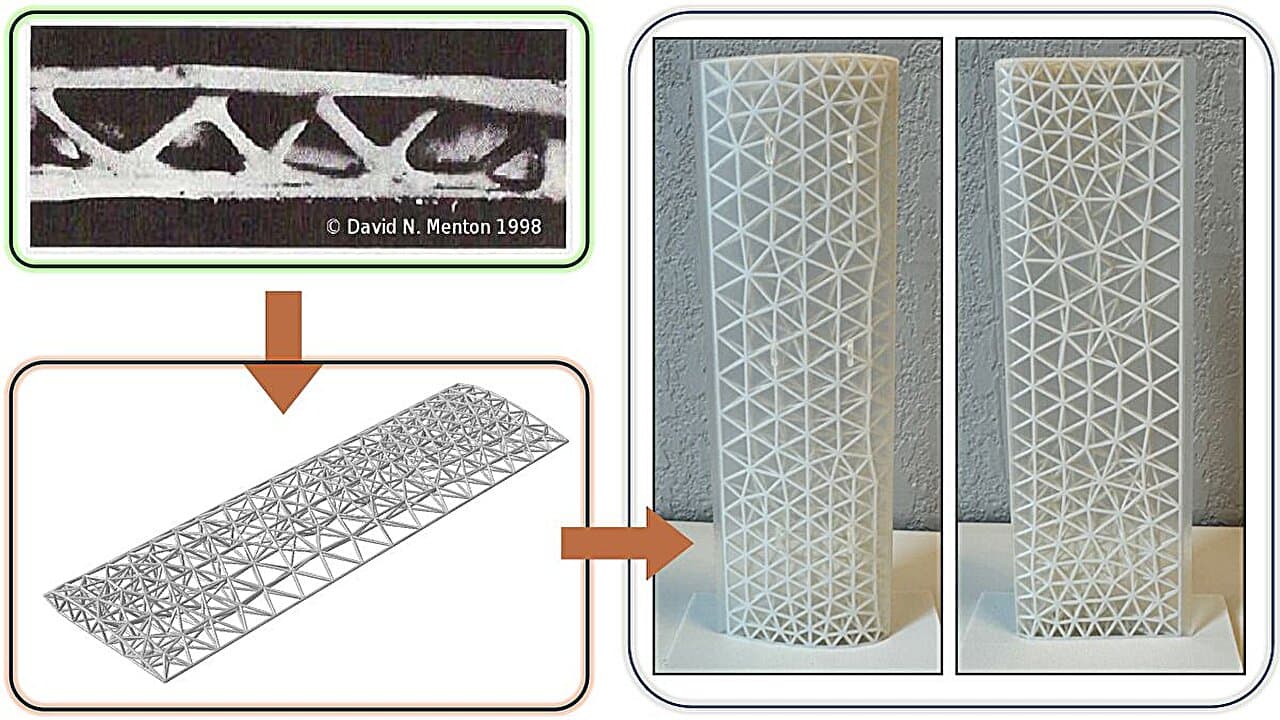
Image: TechXplore
A team at the University of Illinois Urbana-Champaign says bird bones may point to a better way to build aircraft wings. Drawing on the thin, hollow internal structure of vulture bones, Xin Ning and Sepideh Ebad Sichani, Ph.D. '26, designed wing frameworks that move beyond conventional ribs, spars, and stiffeners.
The payoff was substantial. According to the study, published in the International Journal of Solids and Structures, the bird-bone-inspired internal framework delivered 48%–54% improvements in structural efficiency compared with wings built around more traditional wall-like internal structures.
Ning said the challenge in wing design is balancing load capacity against weight.
“If you double the weight, but you only gain a 10% increase in your load, that is not an efficient structure because you are adding more weight than the gain in the load.”
The researchers used both simulation and physical testing. In the numerical phase, they evaluated five groups with five combinations of weighting factors aimed at minimizing wing mass while maximizing load-carrying capacity. Ning said designs that prioritize lower weight tend to produce sparser microstructures, while heavier payloads require parameters that emphasize strength.

Recommended reading
Satellite startups pull $8.1B in half a year
In the experimental phase, the team 3D-printed four wings:
- Two used bird-bone-inspired internal lattices with more irregular shapes
- Two used closed-wall, foam-like internal structures
- Each structure type was printed with one of two weighting factors for a direct lattice-to-wall comparison
Ning said recent advances in 3D printing and additive manufacturing have made it practical to build the kind of complex, curved geometries seen in nature, rather than being limited to straight, parallel internal walls.
He also tied the result to a broader lesson from biology.
“A big takeaway is that biology always wins. We want to look at and learn from biology to help us design better aircraft structures. And with advanced 3D printers, we can realize the design of bioinspired materials.”
The paper is titled “Optimization, additive manufacturing, and testing of bird-bone-inspired materials for aircraft wing designs” by Sepideh Ebad Sichani et al. It carries the DOI 10.1016/j.ijsolstr.2026.113846.

Frontier Editor
Dan is our resident futurist, covering electric mobility, space exploration, and the smart home. He's interested in atoms just as much as bits. Whether it's a new battery chemistry, a reusable rocket, or a protocol that finally makes IoT devices talk to each other, Dan breaks down the engineering that pushes humanity forward.
via TechXplore