• 2 min read
80x Hydrogen Gain From a Cheaper Titanium Dioxide Tweak
RMIT and Chinese collaborators say a modified titanium dioxide system produced more than 80 times more hydrogen in lab tests than untreated material.
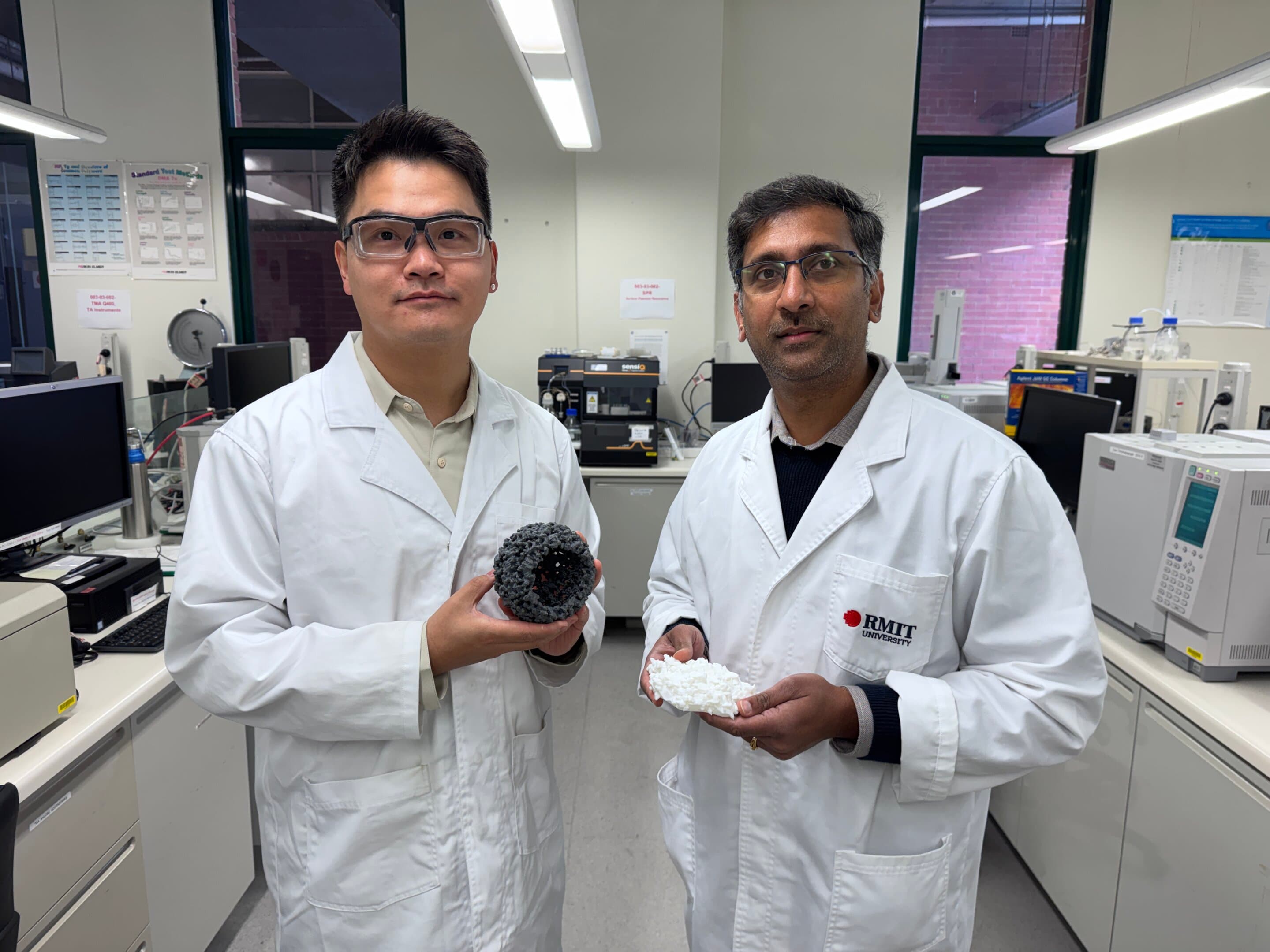
Image: TechXplore
A team led by RMIT University says it has found a low-cost way to sharply improve green hydrogen production by modifying titanium dioxide, a material already used widely in coatings, pigments and energy technologies. In lab tests, the researchers reported hydrogen output more than 80 times higher than a commercial untreated version under the same conditions.
The work was carried out with collaborators from Zhoukou Normal University and Xinyang University in China, and published in Applied Catalysis B: Environment and Energy.
According to the researchers, the goal is to make hydrogen production more efficient without relying on costly metals such as platinum. Lead researcher Dr. Derek Hao of RMIT’s School of Science said the study points to a practical route for future work.
“By showing how a common material can be improved to produce more hydrogen, the study points to a practical direction for future work.”
“If similar gains can be achieved under real-world conditions, it could help bring down the cost of clean hydrogen production at scale.”
Rather than building a new system from scratch, the team altered titanium dioxide in several ways:
- added small amounts of nickel
- introduced defects to guide how energy moves
- shaped the material into tiny hollow spheres to capture light more effectively
The researchers said those changes helped the system retain energy longer and channel it toward hydrogen formation. The strongest performance came under ultraviolet light, though the team also observed some activity under visible light.

Recommended reading
Roscosmos tests AT-Gonets modem that keeps data after power loss
There are important limits to the result. The experiments were done under controlled laboratory conditions in a methanol-containing solution, so the setup demonstrates hydrogen production in a simplified system rather than full water splitting. The material also held its performance over repeated tests, suggesting stability over time.
The paper is “Nanoconfined Ni single-atom Ni–O–Ti atomic asymmetric sites for highly efficient and stable photocatalytic hydrogen evolution,” by Bowen Li et al., published in 2026 with DOI 10.1016/j.apcatb.2026.126888. The next step is to see whether the same approach works under full sunlight and without added chemicals.

Frontier Editor
Dan is our resident futurist, covering electric mobility, space exploration, and the smart home. He's interested in atoms just as much as bits. Whether it's a new battery chemistry, a reusable rocket, or a protocol that finally makes IoT devices talk to each other, Dan breaks down the engineering that pushes humanity forward.
via TechXplore