• 2 min read
LONGi claims 35.5% solar cell efficiency record
LONGi says its crystalline silicon-perovskite tandem solar cell reached 35.5% efficiency, with the result confirmed by the European Solar Test Installation.
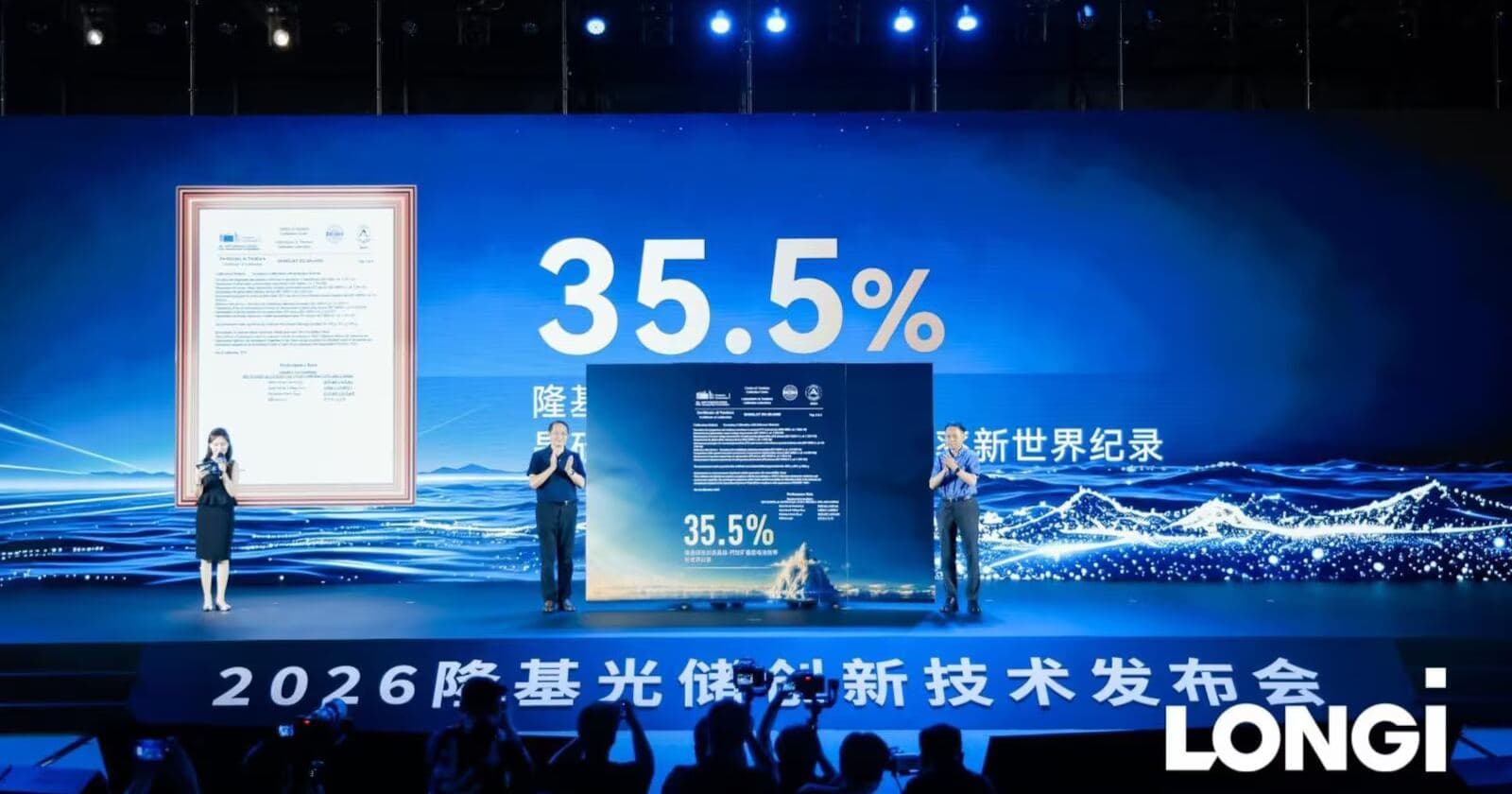
Image: ITzine
LONGi says it has reached 35.5% efficiency with a solar cell, a result the company says was confirmed by the European Solar Test Installation. That is far above today’s commercial silicon panels, which are only now approaching 25% efficiency.
This is not a mass-market panel ready for immediate shipment. The result comes from a crystalline silicon-perovskite tandem cell, the type of design many in the industry see as the most likely way to squeeze out several more percentage points of performance without sharply increasing panel size or weight.
For the market, that may matter more than the record itself. According to the U.S. Energy Information Administration, mainstream solar panels are already close to 25% efficiency, while lab samples have been ahead for years. The hard part is turning a lab milestone into large-scale manufacturing — the long, expensive stretch where many headline-grabbing announcements fall apart.
LONGi’s previous efficiency records
This is not the first time LONGi has raised the bar. The company reported 33.9% in November 2023, then 34.6% in June 2024, and has now added nearly another full percentage point. In solar, each additional point of efficiency is usually harder to achieve than the last.

Recommended reading
COMAC Lands First Foreign C909 Order in Cambodia
LONGi is not alone in chasing perovskite tandems. Samsung, Oxford PV, and others are working on similar approaches because conventional silicon cells are nearing their physical limits, while combining materials offers more headroom than incremental tweaks to older panel designs. LONGi says the theoretical ceiling for these tandem structures could reach 43%.
Commercial scale remains the real test
A lab record does not guarantee market success. Solar developers still face the same questions: how the cell performs over years of use, what production will cost, and whether it can be made at large scale. If any one of those fails, the headline number stays in a press release.
There are also stronger lab results on record. The U.S. National Renewable Energy Laboratory reported a 39.5% efficient cell in 2022, though that remained a research-level result rather than a ready industrial production line.
Against that backdrop, LONGi’s 35.5% looks less like a pure science milestone and more like an attempt to narrow the gap between laboratory performance and a manufacturable product. That matters because, according to the International Energy Agency, solar has become the world’s largest source of new power capacity, and demand for more efficient modules is rising as usable space tightens on rooftops, in cities, and at industrial sites. The next test is whether these cells can survive manufacturing, logistics, and everyday operation without losing that lab-grade number.

Frontier Editor
Dan is our resident futurist, covering electric mobility, space exploration, and the smart home. He's interested in atoms just as much as bits. Whether it's a new battery chemistry, a reusable rocket, or a protocol that finally makes IoT devices talk to each other, Dan breaks down the engineering that pushes humanity forward.
via ITzine