• 2 min read
Self-assembling thin-film electronics emerge from Japan
Kyushu University engineers built thin-film modules that can connect, disconnect, and reconfigure themselves while carrying power and data.
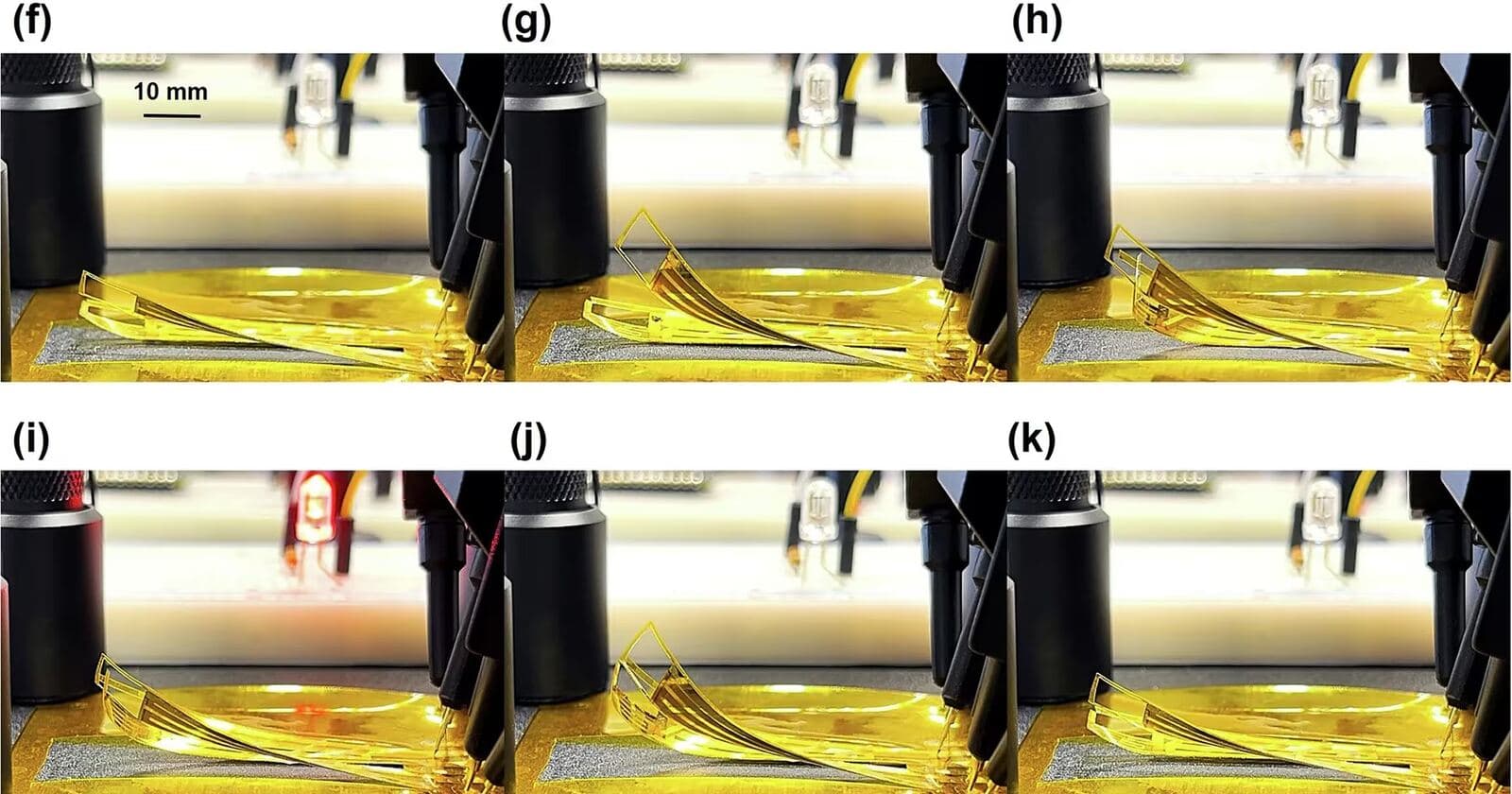
Image: ITzine
Engineers at Kyushu University have demonstrated thin-film electronic modules that can connect, disconnect, and reassemble themselves without human input. The team calls the approach kinetic electronics: instead of packing everything into a rigid board, each module combines circuitry with its own motion mechanism, letting elements physically shift, latch together, and then share power and data through the same connection.
That makes the work stand out from earlier flexible electronics research. Soft sensors and stretchable boards already exist, but giving them the ability to autonomously reconfigure is a much harder problem. According to the researchers, writing in npj Flexible Electronics, the system is built on a thin film that integrates both an electrical circuit and an actuator.
The actuator uses polypropylene and polyimide, two polymers with different thermal expansion properties. A built-in gold microheater supplies heat, causing the film to bend and perform mechanical actions without any external drive system.

Recommended reading
German team speeds PFAS breakdown in water
The team tested several coupling designs:
- one based on loops and hooks
- another using a miniature claw that keeps the connection locked even after power is turned off
That last point matters for soft robotics, because a module can attach to a neighbor and stay in place without continuous power.
The system is designed for 5–12 V operation. In docking mode, a probe-based mechanism produces up to 10 mm of deformation at 1.1 W, while a separate release unit consumes 0.43 W on average. The holding force reaches 618 mgf, or about 6.1 mN.
Once connected, the modules do more than hold together mechanically: they also form an electrical contact, allowing both energy and signals to pass through the same interface. That points to devices assembled from separate parts almost like building blocks, then operating as a single system.
The researchers position the work as especially relevant for implants, medical sensors, and soft robots, where systems need to tolerate deformation and local damage without losing connectivity between nodes. For now, it looks more like a research platform than a mass-market product, but the core idea is clear: modular electronics that can change form and connections with far less human intervention. The paper was published in npj Flex Electronics with DOI 10.1038/s41528-026-00606-9.

Frontier Editor
Dan is our resident futurist, covering electric mobility, space exploration, and the smart home. He's interested in atoms just as much as bits. Whether it's a new battery chemistry, a reusable rocket, or a protocol that finally makes IoT devices talk to each other, Dan breaks down the engineering that pushes humanity forward.
via ITzine