• 2 min read
X-Bat moves closer to runway-free vertical takeoff
Shield AI and GE Aerospace completed key AVEN exhaust tests for X-Bat, clearing the way for a vertical flight test later this year.
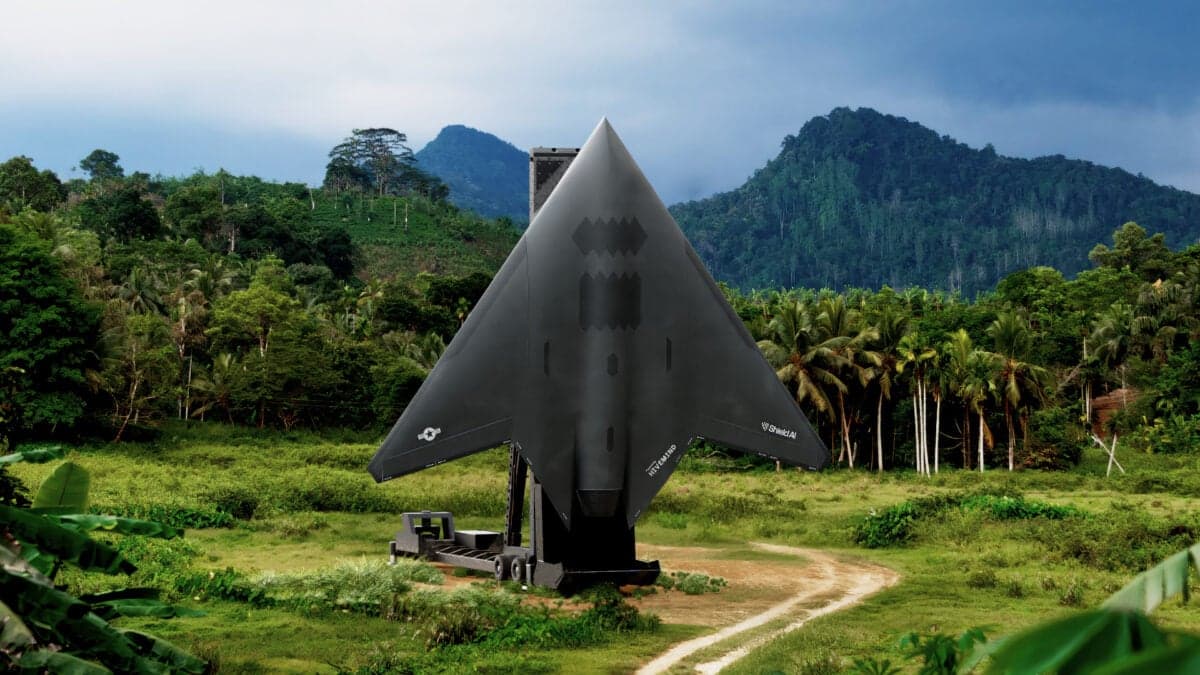
Image: Gizmodo
Shield AI’s X-Bat strike aircraft has cleared a key step toward vertical takeoff, after the company and GE Aerospace completed ground testing of the Axisymmetric Vectoring Exhaust Nozzle (AVEN). The milestone sets up the aircraft for a planned vertical takeoff test later this year.
At GE Aerospace’s site in Peebles, Ohio, engineers modified and integrated the AVEN into the F110-GE-129E engine, then ran functional checkouts and engine light-off tests to verify the propulsion system.
“X-BAT is designed to take off and land vertically from anywhere—no airbase, no runway—and that capability lives or dies with propulsion.”
The AVEN is a 3D thrust-vectoring nozzle first developed in the 1990s for experimental F-16 fighter jets. It redirects engine exhaust in three dimensions for tighter control, including the ability to let an aircraft balance on its tailpipe during vertical takeoff and landing. According to Shield AI, the nozzle has logged 135 flight hours across 95 flights, and this was the first fully integrated test of the nozzle, controls, and engine system since the 1990s.
“The AVEN is what makes vertical flight possible on a platform this size and this capable. Taking hardware with a flight-proven track record and adapting it for that mission has let us move through development at an incredible pace instead of starting from zero.”
X-Bat specs and mission
X-Bat has been in development for over two years and was first shown publicly in October 2025. Shield AI says the aircraft is built to reduce dependence on vulnerable runways by launching from ships, islands, or remote areas.
Recommended reading
Tesla expands Robotaxi service to Orlando and Tampa
The aircraft is designed to carry up to 2,000 pounds (907 kilograms) of weapons in each of its two weapon bays, which the company says are roughly the same size as those on the F-35. It also generates 80 kilowatts of electrical power for systems including electronic warfare suites and signal jamming.
X-Bat runs on Shield AI’s Hivemind autonomous software, allowing it to perform uncrewed vertical takeoffs and landings and fly combat missions alone or alongside crewed aircraft. The system is also designed to keep operating when communication or navigation signals are jammed.
The AVEN will now go through additional testing before being installed on the X-Bat prototype for a flight test later this year.

Frontier Editor
Dan is our resident futurist, covering electric mobility, space exploration, and the smart home. He's interested in atoms just as much as bits. Whether it's a new battery chemistry, a reusable rocket, or a protocol that finally makes IoT devices talk to each other, Dan breaks down the engineering that pushes humanity forward.
via Gizmodo