• 3 min read
Earth could get Saturn-like rings of satellites
Astronomers warn that orbital data centers and mirror fleets could create a bright band of satellites and sharply disrupt night-sky observations.
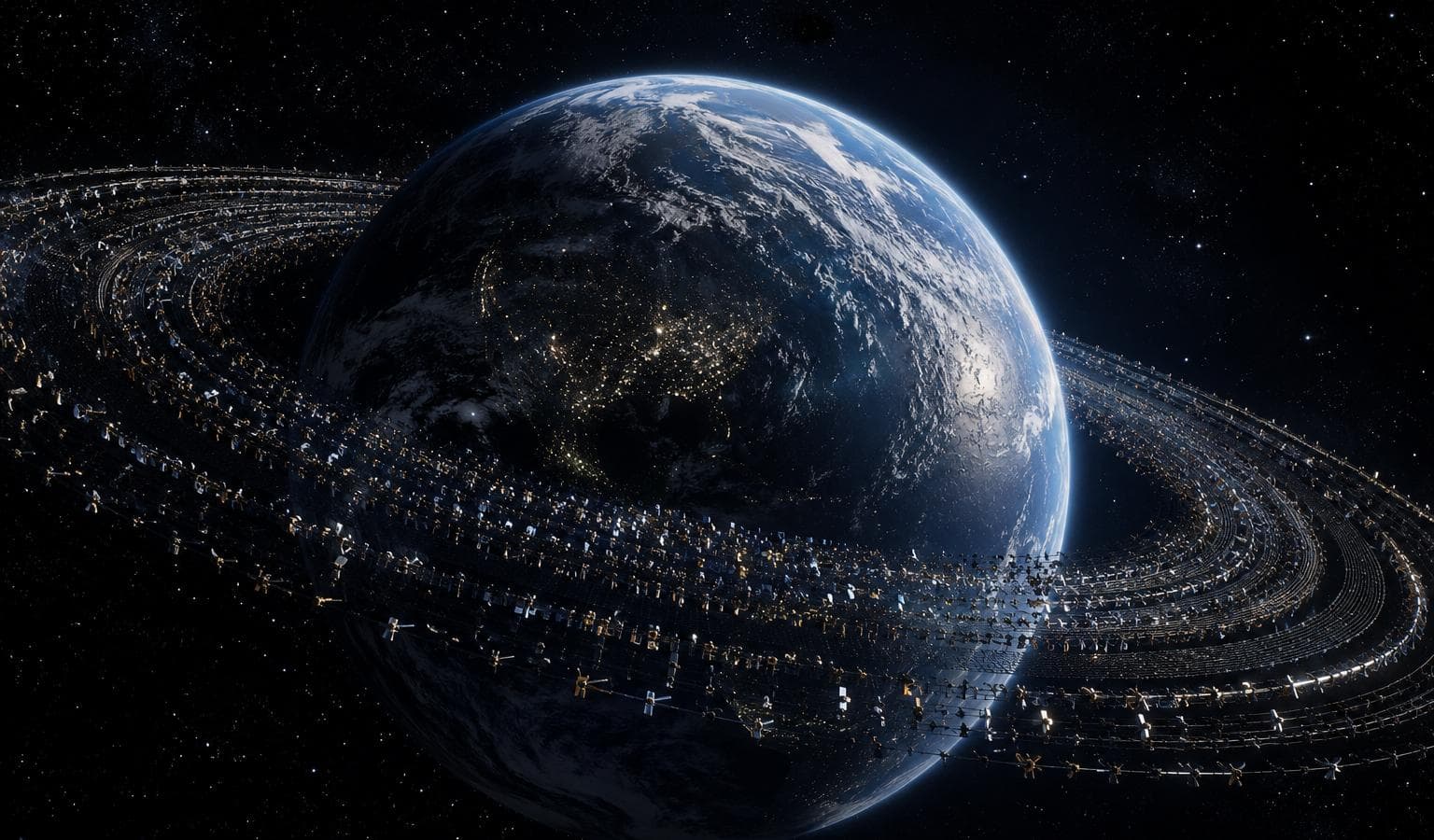
Image: iXBT
Astronomers are warning that Earth could end up with its own version of Saturn’s rings — not made of ice and rock, but of artificial satellites. If planned orbital data centers and sunlight-reflecting satellite mirrors are deployed at the scales companies have proposed, researchers say they could radically alter the night sky and make astronomy far harder.
The concern stems from plans by multiple companies. SpaceX, Blue Origin, Starcloud, Cowboy Space, Orbital and others have proposed orbital data-center projects that together could require launches of more than 1 million satellites. At the same time, Reflect Orbital wants to deploy a constellation of 50,000 satellites equipped with mirrors to reflect sunlight onto selected parts of Earth after sunset.
According to Hugh Lewis, professor of astronautics at the University of Birmingham, those spacecraft would most likely be placed in orbits along the terminator — the boundary between Earth’s day and night sides. That region would let satellites receive sunlight almost continuously, a major advantage for both space-based data centers and orbital mirrors.
If that happens, vast numbers of satellites would be concentrated in a single plane and move in the same direction, creating a bright glowing stripe in the sky.
Recommended reading
This drone spins itself nearly out of sight
“If you look at the night sky, they will be almost in one plane, very close together and moving in one direction. The consequences for the night sky would be absolutely catastrophic.”
A group led by Samantha Lawler of the University of Regina in Canada reached similar conclusions through computer modeling. The team assessed the possible impact of major satellite constellations, including Starmind from SpaceX, Project Sunrise from Blue Origin, and Stampede from Cowboy Space.
Their calculations suggest there could be so many artificial objects in orbit that, at certain times, they would outnumber and outshine most stars visible to observers. Because of Earth’s rotation, that band would pass overhead twice a day — after sunset and before dawn.
Reflect Orbital and night-sky brightness
Researchers are especially worried about Reflect Orbital. The company has already received FCC approval to launch the demonstration satellite Eärendil-1, which will carry an 18 × 18 meter mirror.
According to the European Southern Observatory, if all 50,000 mirror satellites are eventually launched, the brightness of the night sky could rise by about 300%, substantially complicating work for the world’s largest ground-based telescopes.
The American Astronomical Society has also criticized the FCC’s decision to grant Reflect Orbital a license. The group argues that reflected sunlight could interfere not only with scientific observations, but also with pilots, drivers, and telescope operators.
Reflect Orbital says it intends to minimize the effect of its technology on astronomy and has already commissioned independent studies to assess the consequences of orbital mirrors. The FCC, however, said that protecting the night sky and optical astronomy falls outside the agency’s authority — a gap scientists say highlights the lack of any international regulator able to assess the astronomical impact of such megaprojects.

Frontier Editor
Dan is our resident futurist, covering electric mobility, space exploration, and the smart home. He's interested in atoms just as much as bits. Whether it's a new battery chemistry, a reusable rocket, or a protocol that finally makes IoT devices talk to each other, Dan breaks down the engineering that pushes humanity forward.
via iXBT