• 3 min read
Gritt raises $34M to speed solar builds with robots
Gritt has emerged from stealth with $34 million, pitching AI-powered robots that help solar crews install up to 4,000 panels a day.
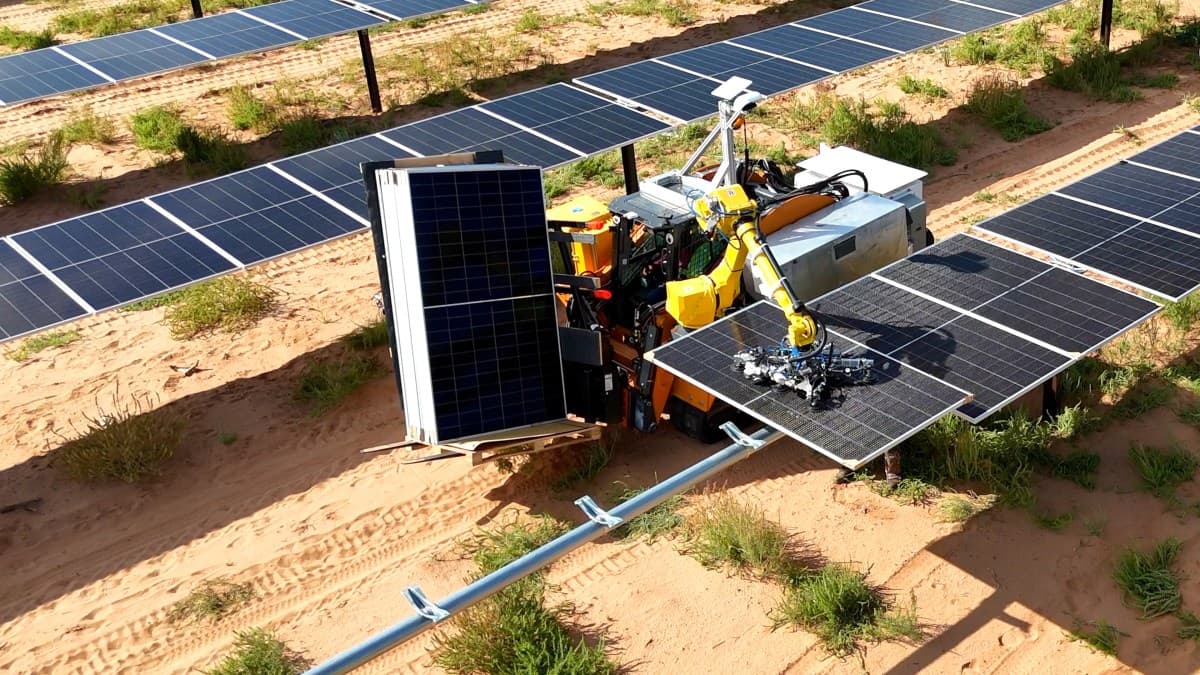
Image: TechCrunch
Solar construction is booming, but the labor needed to build it is harder to find. Gritt, a startup founded by Carnegie Mellon-trained roboticists Puneet Puri and Vishal Dugar, says it can ease that bottleneck with robots built to work on messy outdoor job sites.
The company came out of stealth on Tuesday with a $26 million Series A led by Obvious Ventures, with participation from Union Square Ventures and Active Impact Investment. Including its earlier seed round backed by First Round Capital, Climactic, Congruent Ventures, and VSC Ventures, Gritt’s total funding now stands at $34 million.
Rather than designing its own machines from scratch, Gritt uses off-the-shelf hardware — including rented skidders and robotic arms from companies such as Kawasaki — and layers its own AI models on top. Its first use case is solar installation: unloading large glass panels, carrying them to the metal frames, and positioning them with sub-millimeter accuracy so human workers can fasten them.
“Our thesis is that if we truly want to speed up construction, you need an intelligence which can work in the outdoor, chaotic environments of these construction sites, and it has to be generalizable enough that it can work in these varied environments.”
Gritt says the productivity gains are significant. According to Puri, a typical eight-person crew can install 800 panels a day, while that same crew using Gritt’s systems can install 3,000 to 4,000 panels daily. The startup currently has two systems deployed in the field and says it is under contract to help install 2.8 gigawatts of solar panels over the next 18 months. Its customers include three of the top 10 U.S. power construction companies, and it aims to have 48 systems operating within the next six months.
How Gritt plans to expand beyond panel placement
The company’s longer-term ambition goes well past moving and placing solar panels. Gritt wants its systems to eventually:

Recommended reading
Judge Pauses Paramount’s $111B WBD Deal
- fasten panels
- drill posts
- build the racks panels sit on
- handle other construction work such as tying rebar before concrete is poured
Puri told TechCrunch that newer AI models are what make that broader push realistic. He said building a one-off system for a single task was possible five years ago, but current models make it easier to reuse the same software pipeline across multiple jobs. As one example, he said training Gritt’s system to stack cinder blocks took weeks, while a similar demo for rebar tying took only a day using the same software.
Gritt also sees its robots as more than labor machines. The founders believe the sensors and software running on those systems could help with site management too, such as spotting an open trench before a storm or flagging missing inventory.
The startup is entering a competitive field that includes Luminous Robotics, Cosmic, and China’s Trinabot, all of which are building solar-installation robots. Gritt’s bet is that relying on existing vehicles and arms, instead of custom hardware, could let it scale faster and with a leaner cost structure as demand rises.

Enterprise Editor
Marcus follows the money. He covers enterprise software, cloud architecture, and the tectonic shifts in Big Tech strategy. He translates dense earnings calls and complex M&A activity into actionable insights about where the industry is actually heading. If a tech giant makes a silent pivot, Marcus is usually the first to notice.
via TechCrunch