• 2 min read
NASA’s 100PB climate archive now sits by a Swiss supercomputer
ETH Zurich copied about 100 petabytes of open NASA data to CSCS in Lugano to train weather and climate models on the Alps supercomputer.
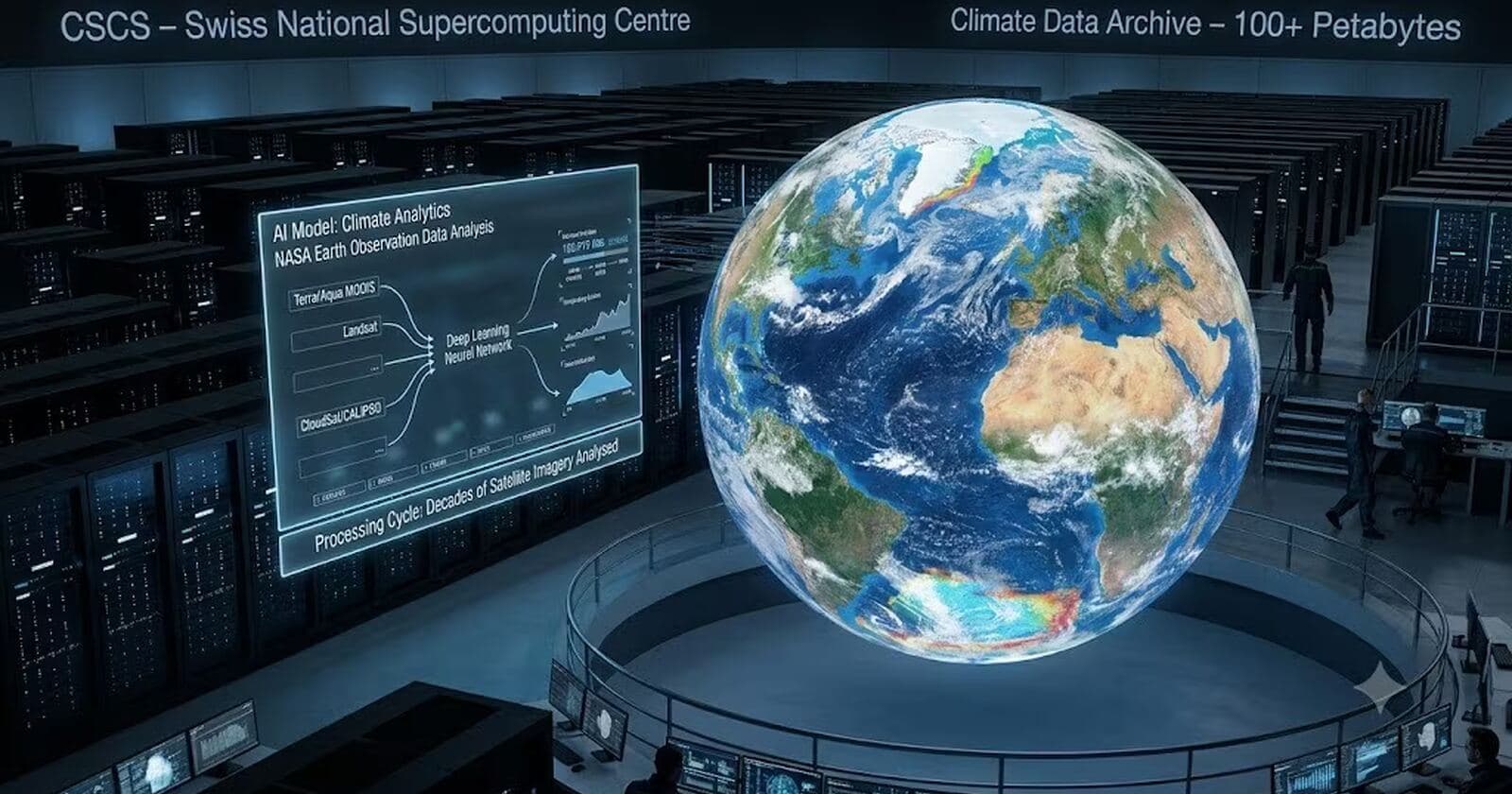
Image: ITzine
ETH Zurich has copied about 100 petabytes of open NASA data to the CSCS supercomputing center in Lugano, Switzerland, creating one of the largest climate datasets assembled next to an AI-focused system in Europe. The transfer took almost a year and includes roughly 6 billion files covering the atmosphere, oceans, glaciers, and greenhouse gas concentrations.
The goal is not just preservation. ETH Zurich says proximity and speed matter: weather and climate models need both massive compute and immediate access to large, well-organized observation archives. With the data now sitting alongside the Alps supercomputer, researchers can train and run models without long transfers between systems.
What’s in the NASA archive
The copied archive spans years of Earth-system observations, including:
- greenhouse gas concentration measurements
- cloud cover and precipitation data
- ice sheet conditions
- ocean parameters
According to the source, the collection can be used both to test scientific hypotheses and to train neural networks on long time series. ETH Zurich also stresses that the data was open: the Swiss team did not take restricted information or break access rules.
The extra copy also serves as a hedge against shifts in funding or priorities affecting the original scientific infrastructure. For long-lived climate archives, that matters; many of these projects operate over decades, not a single budget cycle.
Recommended reading
Green hydrogen study finds hidden pH losses in PEC cells
Why AI weather models need local data
Climate modeling has long been limited not just by the mathematics, but by compute time. The higher the model resolution and the more variables it includes, the more expensive each forecast becomes. That is pushing the field toward a hybrid approach: physics-based models remain the foundation, while AI speeds up selected stages and finds patterns in large observation sets.
The source notes that some AI models can already produce parts of weather forecasts in minutes, while traditional numerical models often take hours. For flood, storm, and drought warnings, that can reduce the delay between data collection and issuing an alert.
This is part of a broader shift. The European Centre for Medium-Range Weather Forecasts is developing its own AI tools, while teams at Google DeepMind and Microsoft have shown that machine learning can accelerate forecasting without discarding physical models.
ETH Zurich’s next step is to add large datasets from NOAA, the U.S. National Oceanic and Atmospheric Administration. If that happens, Alps will gain an even larger pool of inputs that can be matched against forecasts and observations in one place — and tested for whether AI models deliver practical gains in real-world forecasting.

Frontier Editor
Dan is our resident futurist, covering electric mobility, space exploration, and the smart home. He's interested in atoms just as much as bits. Whether it's a new battery chemistry, a reusable rocket, or a protocol that finally makes IoT devices talk to each other, Dan breaks down the engineering that pushes humanity forward.
via ITzine