• 2 min read
Solar windows hit 22% indoor efficiency at 30% transparency
UCL-led researchers built semi-transparent perovskite solar windows that convert 22% of indoor light and 14% of sunlight into electricity.
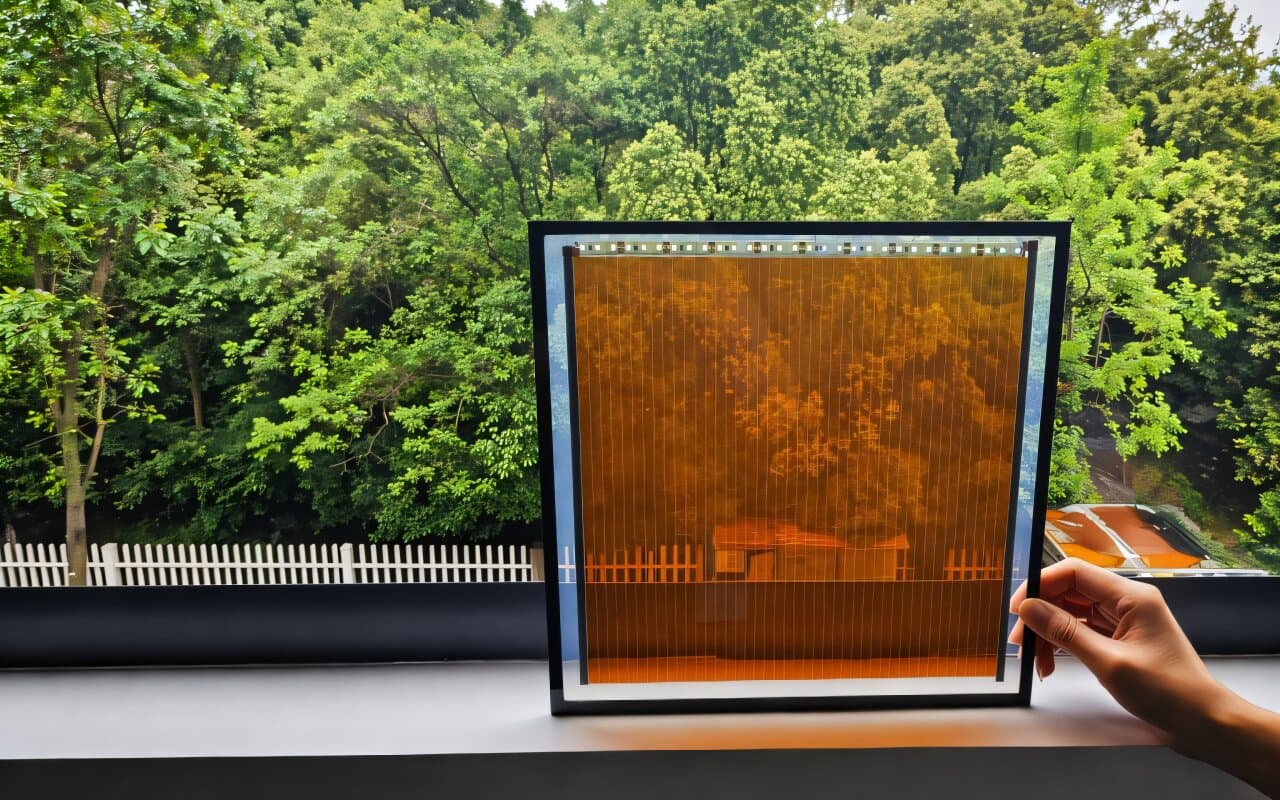
Image: TechXplore
An international team led by UCL says it has built semi-transparent solar windows that can generate electricity from both indoor light and sunlight while still letting through 30% of sunlight. The work, published in Advanced Energy Materials, points to windows that could help buildings produce power even at night, on cloudy days, and in direct sun.
The prototype uses perovskite, a material already gaining ground in outdoor solar panels and better suited than silicon to harvesting indoor light because its composition can be tuned to absorb specific wavelengths. Using computer modeling, the researchers optimized the thickness and arrangement of the cell’s layers to balance transparency and performance.
That led to a perovskite light-absorbing layer just 185 nanometers thick—about 500 times thinner than a human hair and roughly three or four times thinner than in typical solar cells. The team also added 3-trifluoromethyl-1H-1,2,4-triazole, a molecule that reduced defects known as traps and helped stabilize the perovskite crystal structure over time.
Transparent electrode design
A second key change was the electrode. In many perovskite solar cells, the electrode is made of gold, which blocks light. Here, the researchers placed a thin gold layer between two transparent molybdenum oxide layers, reducing reflection and allowing more light to pass through.

Recommended reading
Russian nanosat update boosts links to 100 Mbps
The team built a 30 cm by 30 cm panel and reported:
- 22% conversion efficiency under bright indoor light at 1,000 lux
- 14% conversion efficiency under sunlight
- 80% of original efficiency retained after 300 hours of continuous light exposure in a standard accelerated durability test
Senior author Dr. Mojtaba Abdi-Jalebi of the UCL Institute for Materials Discovery said modern buildings have large window areas that remain mostly unused for energy generation, and that the long-term goal is semi-transparent photovoltaics that are as easy to install as window film. He also said the next step is to engineer flexible solar cells for curved structures such as the Shard, as well as cars, clothes, and backpacks.
Lead author Siming Huang, a Ph.D. student at UCL’s Institute for Materials Discovery, said the technology could also reduce cooling demand by working like tinted windows, blocking part of incoming sunlight and cutting some of the energy used for air conditioning.
The paper is “Multimodal Strategy for Efficient Semi‐Transparent Perovskite Solar Cells and Modules with Record Indoor Performance” by Siming Huang et al. The listed DOI is 10.1002/aenm.70883.

Frontier Editor
Dan is our resident futurist, covering electric mobility, space exploration, and the smart home. He's interested in atoms just as much as bits. Whether it's a new battery chemistry, a reusable rocket, or a protocol that finally makes IoT devices talk to each other, Dan breaks down the engineering that pushes humanity forward.
via TechXplore