• 3 min read
Disabled astronauts may be better suited for Mars
New research suggests some disabilities could be an advantage in space, as the UK Space Agency and Vast plan a 2027 flight for John McFall.
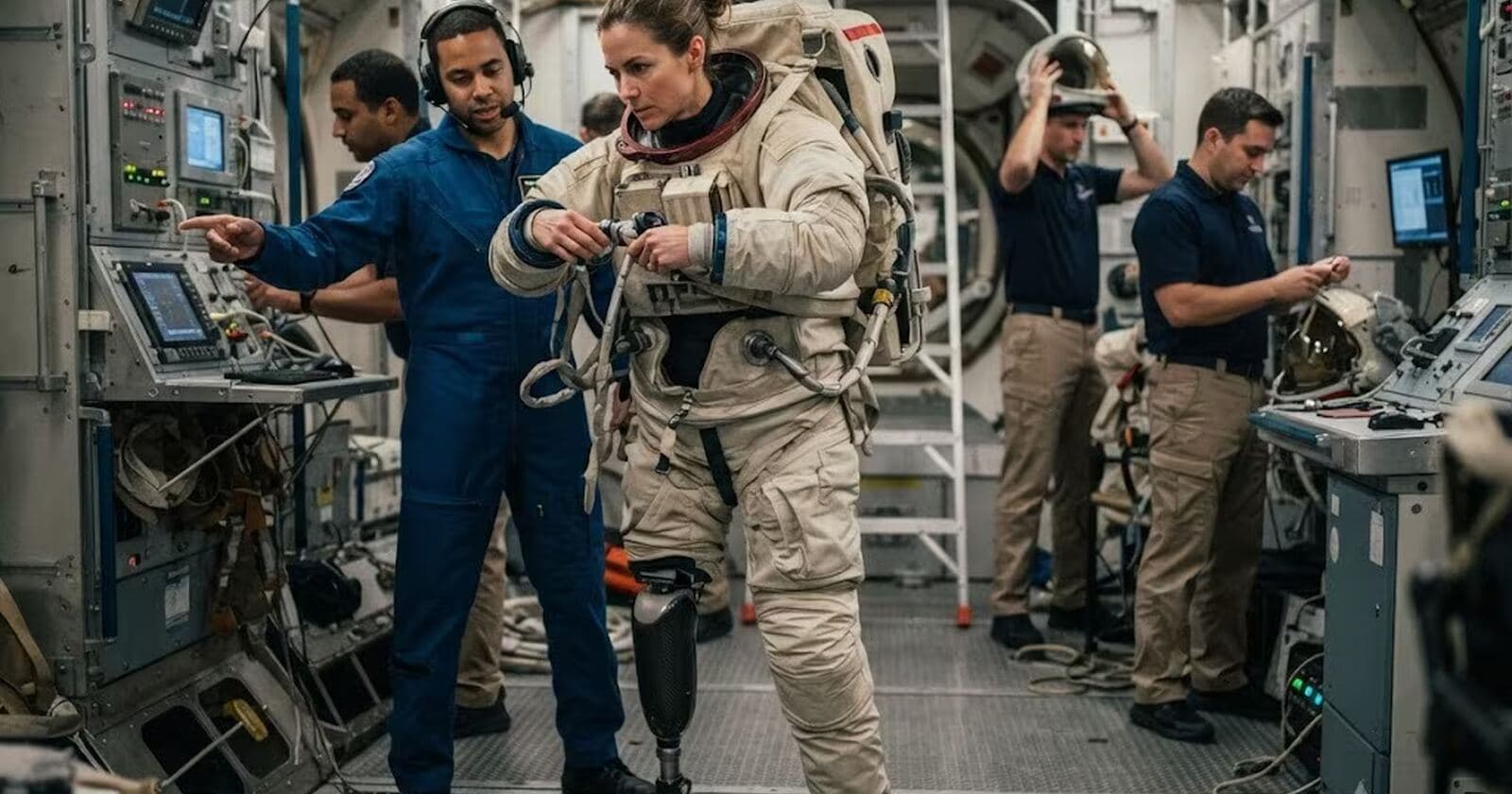
Image: ITzine
The UK Space Agency and Vast plan to send Paralympic sprinter John McFall into space, potentially as soon as 2027. That would be a milestone for inclusion, but the case for it goes beyond representation: newer research suggests people with disabilities may, in some scenarios, be better suited to long-duration missions than the “ideal” astronaut profile space agencies favored for decades.
Human spaceflight long centered on the image of the physically flawless military test pilot. But space has repeatedly shown that identical training does not produce identical physical or psychological responses. In the Mars500 simulation, six participants spent 520 days in conditions mimicking a deep-space mission. Their reactions to isolation varied sharply, with some remaining stable and others developing sleep problems and signs of depression.
History offers earlier examples of capable candidates blocked by formal rules. In the early 1960s, Jerrie Cobb ranked in the top 2% of all NASA-tested candidates, and Wally Funk lasted more than 10 hours in an isolation chamber. Neither flew on Mercury, because NASA required military flight experience, which women were barred from obtaining at the time.
Recommended reading
NASA puts Starlink Mini on Orion for Artemis III
What older and newer experiments show
Researchers are increasingly treating disability not simply as a list of limits, but as a set of traits that could be useful in space. In several experiments, people with hearing impairments or vestibular-system disorders performed better in situations where healthy subjects were quickly disrupted by rocking, spinning, and nausea.
That matters because the first days of weightlessness are hard on most crews: 60–80% of astronauts struggle in early microgravity. Older NASA tests from the 1950s pointed in a similar direction. The agency recruited deaf volunteers for studies on motion sickness and disorientation, and participants with inner-ear damage caused by childhood meningitis outperformed experienced pilots in some trials.
The basic idea is straightforward: someone used to living and working without part of the usual sensory reference system may adapt more calmly in an environment that distorts normal perception.
- Mars500 lasted 520 days and revealed major differences in psychological resilience among similarly trained participants.
- About 17% of astronauts tolerate spaceflight significantly worse than others despite similar preparation.
- Balance problems affect 60–80% of cosmonauts in the first days of weightlessness.
- In the 1950s, NASA tested deaf volunteers for resistance to motion sickness and rotation.
Why John McFall’s mission matters
A flight by John McFall would be the first time a major agency clears a person with a disability for extended scientific work in orbit. For McFall himself, it would also test how prosthetics, medical monitoring, and astronaut training function together in a real mission rather than in simulations.
There is also a practical argument for Mars. One-way communication delays with Earth can reach roughly 20 minutes, meaning crews will have to solve problems far more independently. In that setting, strict adherence to the old astronaut mold may matter less than the ability to improvise when no script fits.
That shift is already underway. In 2021, Hayley Arceneaux, who has a prosthesis, flew to space on SpaceX’s Inspiration4. In 2025, ESA engineer Michaela Benthous became the first wheelchair user in a commercial suborbital flight. If major agencies stop treating such candidates as exceptions and start treating them as viable crew members, the pool of people who can go to space could expand quickly.

Frontier Editor
Dan is our resident futurist, covering electric mobility, space exploration, and the smart home. He's interested in atoms just as much as bits. Whether it's a new battery chemistry, a reusable rocket, or a protocol that finally makes IoT devices talk to each other, Dan breaks down the engineering that pushes humanity forward.
via ITzine