• 2 min read
943 cycles push lead flow batteries further
National Taiwan University researchers extended soluble lead flow battery life to 943 cycles with a nanoscale electrode coating.
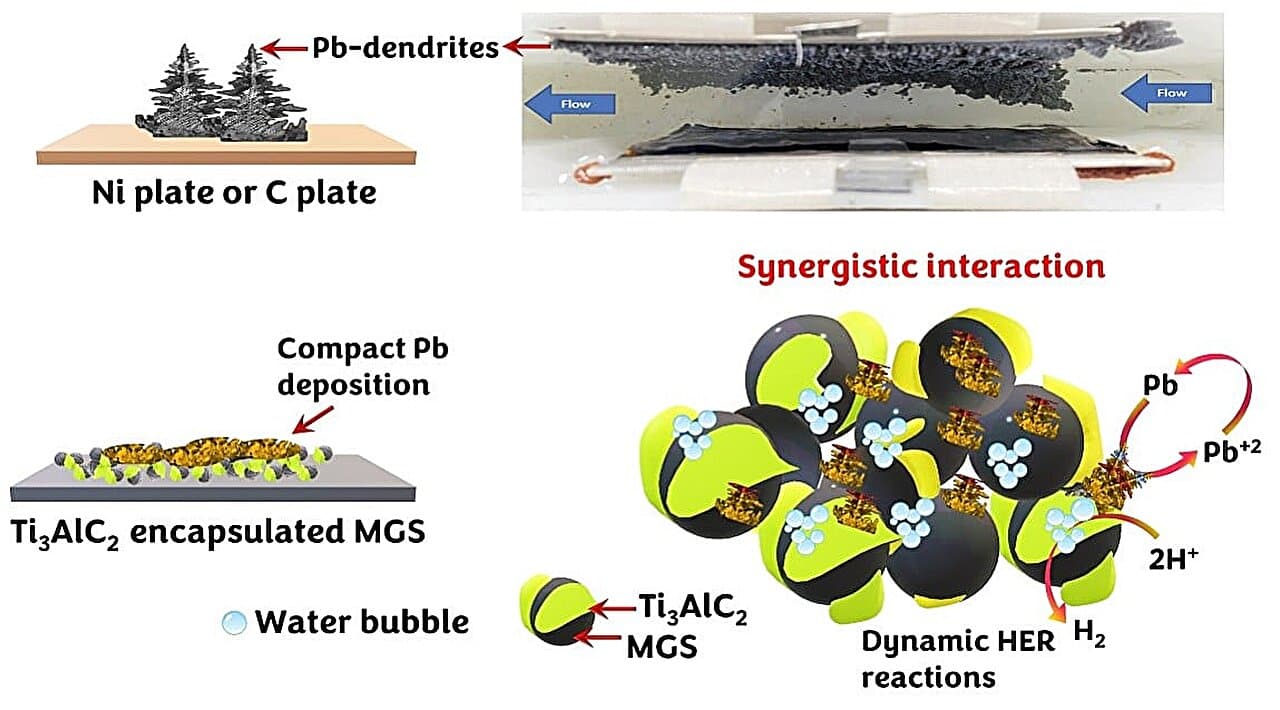
Image: TechXplore
A nanoscale electrode coating has helped soluble lead flow batteries run for 943 charge-discharge cycles, addressing one of the main weaknesses that has limited the chemistry’s use in long-duration energy storage.
As demand for electricity storage rises with renewable energy and AI-driven data centers, researchers are looking for battery systems that are cheap, safe, and easy to scale. Soluble lead flow batteries stand out because they are built from inexpensive lead and can tap into the existing lead-acid battery recycling supply chain.
The catch has been the electrodes. Their carbon-based surfaces repel the water-based electrolyte, making it harder for the liquid to reach the electrode and slowing the reactions that charge and discharge the battery.
A team led by Professor Hsun-Yi Chen at the Department of Biomechatronics Engineering and Bioenergy Research Center, National Taiwan University, tackled that by modifying the electrode surface at the nanoscale. The researchers coated porous graphite spheres with a thin layer of Ti3AlC2, a MAX phase material that combines ceramic and metallic properties. That changed the surface from water-repelling to water-attracting, helping the electrolyte move through the electrode more effectively and reducing ion-transport bottlenecks.

Recommended reading
China clears first commercial brain implant for paralysis
The study, published in the Journal of Energy Storage, also included a modular prototype battery that powered LED lights and a small fan, showing the approach can work beyond a lab setup.
“By simply re-engineering the electrode surface, we were able to unlock significantly longer battery life without redesigning the entire system, which is an important step toward making long-duration, grid-scale energy storage more practical and affordable.”
The researchers said the same surface-engineering approach could also help other battery chemistries with similar transport limits.

Frontier Editor
Dan is our resident futurist, covering electric mobility, space exploration, and the smart home. He's interested in atoms just as much as bits. Whether it's a new battery chemistry, a reusable rocket, or a protocol that finally makes IoT devices talk to each other, Dan breaks down the engineering that pushes humanity forward.
via TechXplore